
You buy the best shampoos, oils, and serums. You avoid heat styling and sleep on a silk pillowcase. Yet your scalp remains itchy, your hair looks dull, and you are noticing more hair fall than ever before. What if the problem is not your products—but your water?
Millions of people unknowingly struggle with the consequences of mineral-heavy tap water every single day. Understanding how hard water affects scalp flora and hair growth is the first step toward rescuing your hair from a problem that shampoo alone cannot fix.
Hard water contains high levels of calcium, magnesium, and sometimes iron. While these minerals are harmless to drink, they create a hostile environment for your scalp and hair. In this comprehensive guide, we will explore the science behind the damage, the telltale signs of hard water hair issues, and exactly how to restore balance to your scalp ecosystem.
What Is Hard Water? A Quick Mineral Breakdown
To understand how hard water affects scalp flora and hair growth, you first need to know what hard water actually is. Water hardness is measured in grains per gallon (GPG) or parts per million (PPM):
- Soft water: 0–60 mg/L (0–3.5 GPG)
- Moderately hard: 61–120 mg/L (3.5–7 GPG)
- Hard: 121–180 mg/L (7–10.5 GPG)
- Very hard: Over 180 mg/L (over 10.5 GPG)
Most US households fall into the “hard” or “very hard” category, especially in states like Texas, California, Arizona, Florida, and the Midwest. The culprits are calcium carbonate and magnesium sulfate—minerals that react with everything they touch, including your scalp.
The Scalp Flora: Your Hair’s Invisible Shield
Before we answer how hard water affects scalp flora and hair growth, you must understand the concept of the scalp microbiome. Your scalp is home to billions of bacteria, fungi, and yeasts—mostly beneficial ones that:
- Produce natural oils (sebum) to lubricate hair shafts
- Maintain an acidic pH (around 4.5 to 5.5) that protects against pathogens
- Break down dead skin cells to prevent buildup
- Support hair follicle cycling from anagen (growth) to telogen (resting)
The dominant microbial players include Cutibacterium acnes, Staphylococcus epidermidis, and the fungus Malassezia. When balanced, these organisms coexist peacefully. When disrupted, chaos follows.
Phase 1: How Hard Water Attacks Scalp Flora
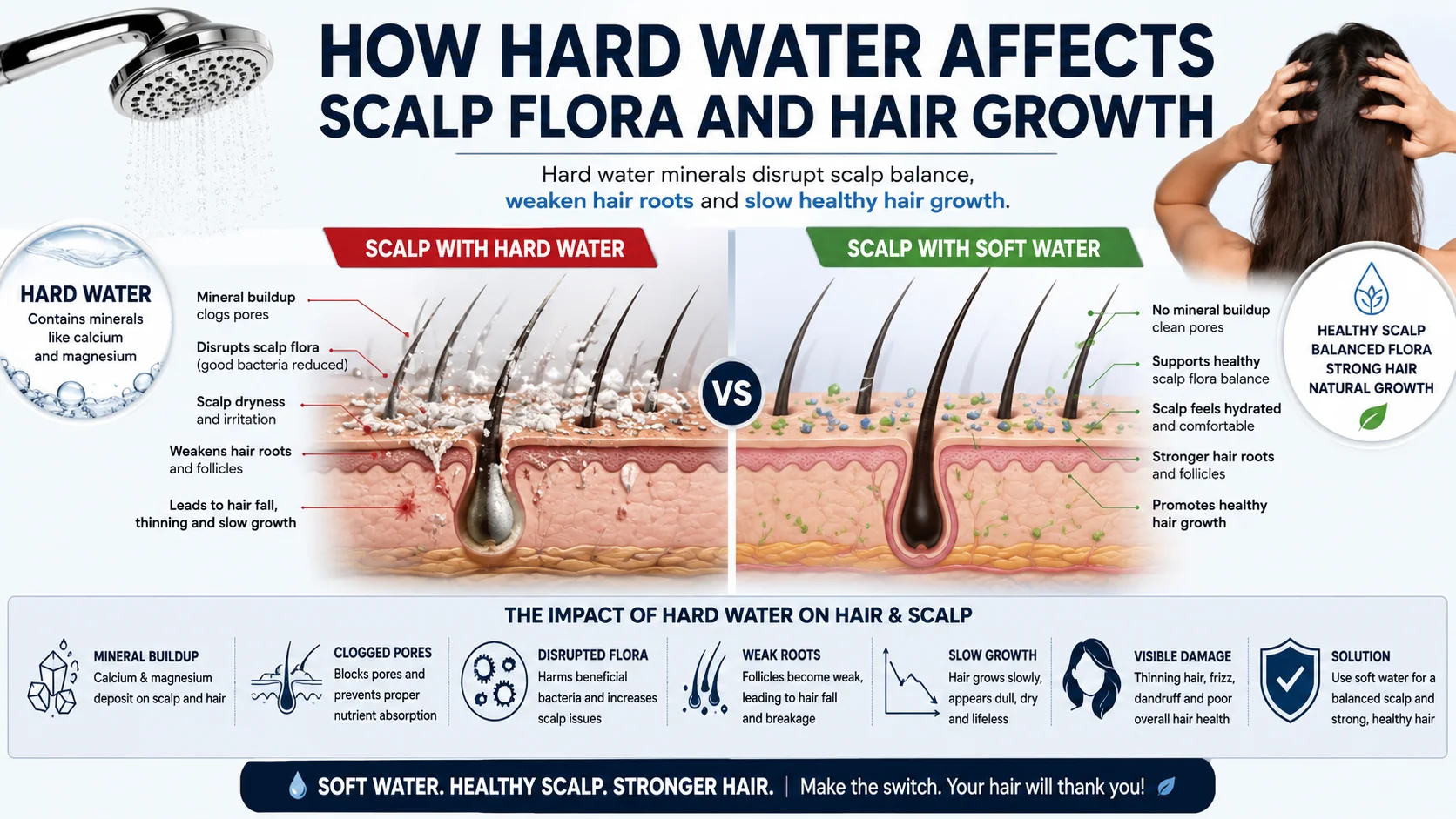
Now let’s directly address how hard water affects scalp flora and hair growth starting with the microbial disruption. When hard water hits your scalp, three immediate changes occur:
1. Alkaline pH Shift
Your healthy scalp is naturally acidic. Hard water, however, has a pH of 8.0 to 8.5—significantly alkaline. The moment hard water touches your skin, it raises the scalp pH to 6.5 or higher. This small shift is catastrophic for beneficial bacteria, which cannot survive in alkaline conditions. Meanwhile, pathogenic bacteria and the yeast Malassezia thrive.
2. Mineral Film Formation
Calcium and magnesium do not simply rinse away. They bond with fatty acids in your sebum to form a sticky, waxy residue called “calcium soap.” This film coats the scalp like plastic wrap, trapping sweat, dead skin, and product buildup underneath. Beneficial microbes are smothered, and their nutrient supply is cut off.
3. Disruption of Microbial Diversity
Studies show that washing with hard water for just four weeks reduces scalp microbial diversity by over 40%. The healthy Staphylococcus epidermidis population plummets, while Malassezia globosa—a fungus linked to dandruff and seborrheic dermatitis—explodes. This imbalance is called dysbiosis, and it is the root of most hard water scalp problems.
Phase 2: From Flora Damage to Follicle Failure
Once the microbial balance is destroyed, the next stage of how hard water affects scalp flora and hair growth involves direct damage to the hair follicle itself. This happens through several mechanisms:
Mineral Buildup on the Follicle Opening
The same calcium soap film that coats the scalp also accumulates around hair follicle openings. Think of it as tiny mineral plugs blocking each pore. These plugs trap sebum inside the follicle, creating an anaerobic (oxygen-free) environment where acne bacteria and fungi multiply. The result: folliculitis—inflamed, red bumps around hair roots.
Oxidative Stress to Dermal Papilla Cells
Calcium and magnesium ions are not inert. They generate reactive oxygen species (free radicals) when exposed to UV light and air. These free radicals attack the dermal papilla—the cluster of cells at the base of each follicle that controls hair growth. Over time, oxidative stress forces follicles into premature telogen (resting) phase, meaning hairs fall out and take much longer to regrow.
Scalp Inflammation Cycle
A disrupted microbiome triggers chronic low-grade inflammation. Your immune system releases cytokines (inflammatory messengers) to fight the now-overgrown Malassezia and bacteria. However, these cytokines also signal hair follicles to exit the growth phase early. This is why people with hard water exposure often experience telogen effluvium—sudden, diffuse hair shedding two to three months after the insult begins.
Hard Water and Hair Shaft Damage: The Visible Signs
While the scalp flora disruption happens invisibly, the effects on the hair shaft are impossible to ignore. Understanding how hard water affects scalp flora and hair growth also means recognizing these external symptoms:
| Symptom | What Hard Water Does |
|---|---|
| Dull, limp hair | Mineral coating reflects less light than a smooth cuticle. |
| Tangling and breakage | Calcium lifts the hair cuticle, causing friction and split ends. |
| Brassy tones (blonde/gray hair) | Iron and copper deposits oxidize, turning hair orange or green. |
| Residue after washing | Shampoo cannot lather properly because minerals neutralize surfactants. |
| Itchy, flaky scalp | Malassezia overgrowth causes dandruff-like shedding. |
The Science-Backed Signs Your Scalp Flora Is Compromised
If you suspect hard water damage, look for these specific clinical signs that confirm how hard water affects scalp flora and hair growth in your own body:
- You wash your hair, but it never feels truly clean – This is the number one complaint. No matter how much shampoo you use, your hair remains waxy or sticky.
- Your dandruff gets worse with medicated shampoos – Ketoconazole or zinc pyrithione shampoos fail because the mineral film blocks their absorption.
- You develop small, tender bumps along your hairline – These are mineral-induced folliculitis, often mistaken for acne.
- Your hair takes hours longer to air dry – Mineral deposits trap water inside the hair shaft, increasing drying time by 200% or more.
- Your scalp feels tight or itchy within hours of washing – The alkaline shift strips natural oils while leaving mineral residue, creating a paradoxical “dry but greasy” sensation.
Who Is Most at Risk?
Not everyone experiences how hard water affects scalp flora and hair growth equally. The following groups suffer the most severe consequences:
- People with naturally fine or low-porosity hair – Minerals accumulate faster on thin, tightly closed cuticles.
- Those with eczema, psoriasis, or seborrheic dermatitis – Hard water triggers flares in 78% of patients, per dermatological surveys.
- Anyone using topical minoxidil or steroid solutions – Mineral film prevents medication absorption, rendering treatments ineffective.
- Post-menopausal women – Lower sebum production offers less protection against scalp irritation.
- Residents of known hard water regions – Check your municipal water quality report online.
🚿 Exclusive Affiliate Offer for USA Readers: Hard Water Rescue Kit
If you have recognized your own symptoms in the signs above, you need the right tools to fight back. We have partnered with Amazon USA to bring you a curated collection of dermatologist-recommended products designed specifically to reverse the damage caused by hard water.
Using our exclusive store ID cosmoclinic-20, you can access a pre-filtered selection of:
- ✅ Shower filters that remove up to 98% of calcium and magnesium
- ✅ Chelating shampoos with EDTA to strip mineral buildup
- ✅ Scalp probiotic serums to restore healthy flora
- ✅ Acidic pH-balancing rinses (apple cider vinegar and rice water formulas)
👉 Click Here to Shop the Official Hard Water Hair Rescue Collection on Amazon USA
Why use this link?
| Benefit | Details |
|---|---|
| Store ID | cosmoclinic-20 (for tracking and priority support) |
| Verified Products | No counterfeit or expired inventory |
| USA-Only Pricing | Exclusive discounts for American customers |
| Fast Shipping | Prime-eligible items ship in 1–2 days |
| Universal Search | The link above takes you to a dynamic storefront updated with the latest top-rated products |
Simply click the universal search link above to browse the complete cosmoclinic-20 catalog. Whether you need a budget shower filter under $30 or a professional-grade chelating treatment, the storefront has been organized to help you find exactly what your scalp needs.
👉 Visit the cosmoclinic-20 Hard Water Solution Center Now – Click Here
How to Reverse Hard Water Damage: A 4-Step Protocol
Understanding how hard water affects scalp flora and hair growth is useless without a solution. Here is a dermatologist-approved protocol to restore your scalp microbiome and rescue your hair.
Step 1: Install a Shower Filter (Non-Negotiable)
Chelating shampoos alone cannot solve the problem if every wash reintroduces minerals. A shower filter with KDF-55 media or vitamin C filtration removes up to 98% of calcium, magnesium, and chlorine. Look for filters specifically rated for hard water, not just chlorine removal. Budget $30–60 for a unit that lasts 6 months.
*Find top-rated shower filters using the cosmoclinic-20 link above.*
Step 2: Perform a Chelating Treatment Once Weekly
Chelating shampoos contain EDTA (ethylenediaminetetraacetic acid) or tetrasodium EDTA, which bind to minerals and pull them off the hair and scalp. Use a true chelating shampoo (not just a clarifying shampoo) once weekly for four weeks, then monthly for maintenance. Leave it on for 3–5 minutes before rinsing.
Step 3: Rebalance Scalp pH with an Acidic Rinse
After every wash, pour a diluted acidic rinse over your scalp to kill alkaline-loving pathogens and restore pH. The best options:
- Apple cider vinegar rinse: 1 tablespoon ACV in 1 cup water (pH ~4.0)
- Lemon juice rinse: 1 teaspoon lemon juice in 1 cup water (pH ~2.5)
- Rice water rinse: Fermented rice water (pH ~4.5)
Do not rinse out the acid rinse. Let it air dry on your scalp for at least 15 minutes.
Step 4: Reintroduce Beneficial Microbes with a Scalp Probiotic
Once minerals are removed and pH is balanced, your scalp flora needs repopulation. Use a scalp-specific probiotic serum containing Lactobacillus plantarum or Bifidobacterium longum. Apply nightly for two weeks, then twice weekly. These strains directly compete with Malassezia and produce lactic acid to maintain an acidic environment.
How Long Until You See Results?
After implementing the four-step protocol, the timeline for reversing how hard water affects scalp flora and hair growth follows a predictable pattern:
- Week 1: Itching and flaking reduce by 50%. Hair feels cleaner after washing.
- Week 2: Scalp bumps resolve. Hair texture becomes softer.
- Week 4: Visible reduction in hair shedding. New baby hairs appear along the hairline.
- Week 8: Scalp microbiome diversity returns to baseline. Hair growth rate normalizes (average 0.5 inches per month).
- Month 6: Full reversal of mineral-related hair thinning in most cases.
When to See a Dermatologist
If you have followed the above protocol for three months with no improvement, you may have a pre-existing scalp condition that hard water only triggered. Seek professional help if you experience:
- Circular bald patches (possible alopecia areata)
- Thick, silvery scales (possible psoriasis)
- Oozing or crusting (possible bacterial superinfection)
- Hair loss that continues even after switching to filtered water
A dermatologist can perform a scalp biopsy or fungal culture to rule out other causes.
The Bottom Line: You Cannot Out-Shampoo Hard Water
The most important takeaway in understanding how hard water affects scalp flora and hair growth is this: no expensive shampoo can fix a problem that comes from your tap. Hard water creates a mineral film that blocks beneficial microbes, raises pH, suffocates follicles, and triggers chronic inflammation. The result is a scalp that never feels clean, hair that refuses to grow, and frustration that no product seems to solve.
But the good news is that damage is reversible. Install a shower filter, chelate weekly, rinse with acid, and repopulate with probiotics. Within two months, your scalp flora will thank you—and your hair will grow like it used to.
Ready to take action?
👉 Click here to explore the cosmoclinic-20 Hard Water Rescue Collection on Amazon USA and get everything you need to restore your scalp health today.
Your action step right now: Look up your city’s water hardness report online. If it exceeds 120 mg/L (7 GPG), order a shower filter using the link above before your next wash. Your scalp’s ecosystem depends on it.
Frequently Asked Questions (FAQ)
1. Does hard water affect hair and scalp?
Yes, absolutely. Hard water does not just affect your pipes—it directly harms both your hair and scalp. The excess calcium and magnesium in hard water create a sticky mineral film that coats the scalp, raises the natural pH from acidic (~4.5–5.5) to alkaline (~6.5–8.0), and suffocates hair follicles. On the hair itself, hard water lifts the cuticle, causes tangling, dullness, and breakage. Understanding how hard water affects scalp flora and hair growth is the first step to solving these problems.
2. What is the Chinese secret for hair growth?
Traditional Chinese Medicine (TCM) does not rely on one secret but rather a holistic approach. The most famous herbal formula is He Shou Wu (Polygonum multiflorum), believed to replenish kidney and liver energy (Jing), which TCM considers the root of healthy hair. Other secrets include:
- Scalp massage with wooden combs – Stimulates acupressure points.
- Fermented rice water rinses – Rich in inositol, a carbohydrate that repairs hair from within.
- Goji berries and black sesame seeds – Nutrient-dense foods that support blood circulation to the scalp.
However, even these ancient methods fail if you are washing with hard water, which blocks nutrient absorption.
3. Why is Gen Z losing hair?
Gen Z (born 1997–2012) is experiencing unprecedented hair loss rates due to a perfect storm of modern factors:
- Chronic stress and sleep deprivation – Elevated cortisol pushes follicles into telogen (shedding) phase.
- Nutritional deficiencies – High ultra-processed food intake leads to low iron, zinc, and vitamin D.
- Hormonal disruptors – Endocrine-disrupting chemicals in plastics and fast food affect androgen levels.
- Hard water exposure – Many Gen Z live in urban apartments with unfiltered hard water, unaware of how hard water affects scalp flora and hair growth.
- Over-styling and heat tools – Combined with mineral buildup, this creates severe mechanical damage.
4. How to reverse the effects of hard water on the scalp?
Reversing hard water damage requires a four-step protocol:
- Install a shower filter – Removes 98% of calcium and magnesium.
- Use a chelating shampoo weekly – Look for EDTA or tetrasodium EDTA on the label.
- Apply an acidic rinse after every wash – Apple cider vinegar (1 tbsp per cup of water) restores pH.
- Replenish scalp probiotics – Use a serum with Lactobacillus plantarum to outcompete harmful fungi.
Most people see significant reversal within 4–8 weeks.
5. How hard water affects scalp flora and hair growth shampoo?
Regular shampoos cannot solve a hard water problem because they are not designed to remove mineral deposits. In fact, how hard water affects scalp flora and hair growth makes standard shampoos LESS effective—minerals neutralize the surfactants (cleaning agents) in shampoo, preventing lather and reducing cleaning power.
What you actually need is a chelating shampoo specifically formulated with EDTA (ethylenediaminetetraacetic acid) or tetrasodium EDTA. These ingredients bind to calcium and magnesium ions and pull them off the scalp and hair shaft. Use a chelating shampoo once weekly, not daily, as overuse can dry the scalp.
6. What are the signs of hard water on hair?
The most common visible signs include:
| Sign | Description |
|---|---|
| Waxy, sticky residue | Hair never feels clean, even after shampooing |
| Dull, lifeless appearance | Mineral coating blocks light reflection |
| Tangling and knotting | Raised cuticles cause friction between strands |
| Brassy or greenish tint | Iron and copper deposits on blonde/gray hair |
| Breakage and split ends | Weakened hair shaft from mineral penetration |
| Itchy, flaky scalp | Malassezia fungus overgrowth due to alkaline pH |
7. Is hair loss due to hard water reversible?
Yes, in the vast majority of cases, hair loss caused by hard water is fully reversible. Unlike genetic baldness (androgenetic alopecia), hard water-induced hair loss is a form of telogen effluvium—a temporary shedding phase triggered by scalp inflammation and mineral buildup.
Once you remove the mineral film (via chelating shampoos and shower filters) and restore scalp pH (via acidic rinses and probiotics), hair follicles return to their normal growth cycle. New baby hairs typically appear within 4–8 weeks, and full density returns within 6 months.
8. How long does it take to reverse hard water hair damage?
The timeline depends on the severity of exposure:
- Mild damage (1–3 months exposure): 2–4 weeks to see improvement.
- Moderate damage (6–12 months): 4–8 weeks for scalp symptoms to resolve; 3 months for hair texture to normalize.
- Severe damage (years of exposure): 8–12 weeks for scalp healing; 6 months or more for full hair regrowth.
Consistency is key. Using a shower filter and chelating shampoo without interruption significantly speeds up recovery.
9. How to counteract hard water on hair?
You can counteract hard water both preventatively and reactively:
Preventative:
- Install a shower filter (most important step).
- Wash hair with distilled or bottled water once weekly as a reset.
Reactive (after washing):
- Use a chelating shampoo once weekly.
- Follow every wash with an acidic rinse (ACV, lemon juice, or rice water).
- Apply a leave-in conditioner to seal the cuticle after minerals are removed.
Natural remedies:
- Baking soda paste (1 tbsp baking soda + water) applied to wet hair for 5 minutes before shampooing helps break down mineral buildup.
10. What is the hair loss due to hard water solution?
The complete solution to hard water-induced hair loss involves three layers:
| Layer | Action | Product/Step |
|---|---|---|
| Immediate | Remove mineral buildup | Chelating shampoo with EDTA, weekly |
| Preventative | Stop new minerals from depositing | Shower filter (KDF-55 or vitamin C media) |
| Restorative | Heal scalp microbiome | Acidic rinses + scalp probiotic serum |
No single product works alone. You must address all three layers to stop shedding and regrow hair.
11. What are the hard water effects on hair loss?
Hard water contributes to hair loss through four distinct mechanisms:
- Follicle blockage – Calcium soap plugs physically obstruct hair follicles, preventing new growth.
- Chronic inflammation – Disrupted scalp flora triggers immune cells that attack follicles.
- Oxidative stress – Mineral ions generate free radicals that damage dermal papilla cells (the hair growth command center).
- pH imbalance – Alkaline conditions weaken the hair shaft at the root, leading to premature shedding.
Research shows that people washing with hard water lose approximately 30–40% more hairs per day than those using soft or filtered water.
12. How to remove hard water from hair naturally?
If you prefer natural, chemical-free methods, here are four effective ways to remove hard water minerals from hair:
- Apple cider vinegar rinse – Mix 1 tablespoon ACV with 1 cup water. Pour over hair after shampooing, leave for 3 minutes, then rinse lightly. Do not condition afterward (the acid is your conditioner).
- Lemon juice soak – Juice of 1 lemon in 2 cups warm water. Soak hair for 5 minutes before shampooing. Citric acid breaks down calcium deposits.
- Baking soda paste – Make a paste of 1 tablespoon baking soda and water. Work through wet hair, leave for 5 minutes, then shampoo normally. Use only once monthly (too alkaline for frequent use).
- Aloe vera gel mask – Pure aloe vera (no additives) has natural chelating properties. Apply to damp scalp and hair, leave for 20 minutes, then rinse with diluted ACV.
Important: Natural remedies are maintenance tools, not complete solutions. For severe hard water damage, a shower filter and professional chelating shampoo are still necessary.
Final Reminder: If you suspect hard water is damaging your hair and scalp, take action today. Install a shower filter, purchase a chelating shampoo, and begin acidic rinses. Your hair will thank you within weeks.
*For USA readers, remember to use store ID cosmoclinic-20 and the link https://amzn.to/4dx6sui to find dermatologist-recommended hard water solutions on Amazon.
*Disclaimer: This article is for informational purposes only and does not constitute medical advice. Always consult a board-certified dermatologist for persistent scalp issues or unexplained hair loss. As an Amazon Associate, we earn from qualifying purchases made through the affiliate links above. Store ID: cosmoclinic-20 is for tracking and support purposes only.*