

Medically reviewed by Dr. Mohammed Abdul Azeem Siddiqui, MBBS (30+ years clinical experience)
What blood tests are done for hair loss?
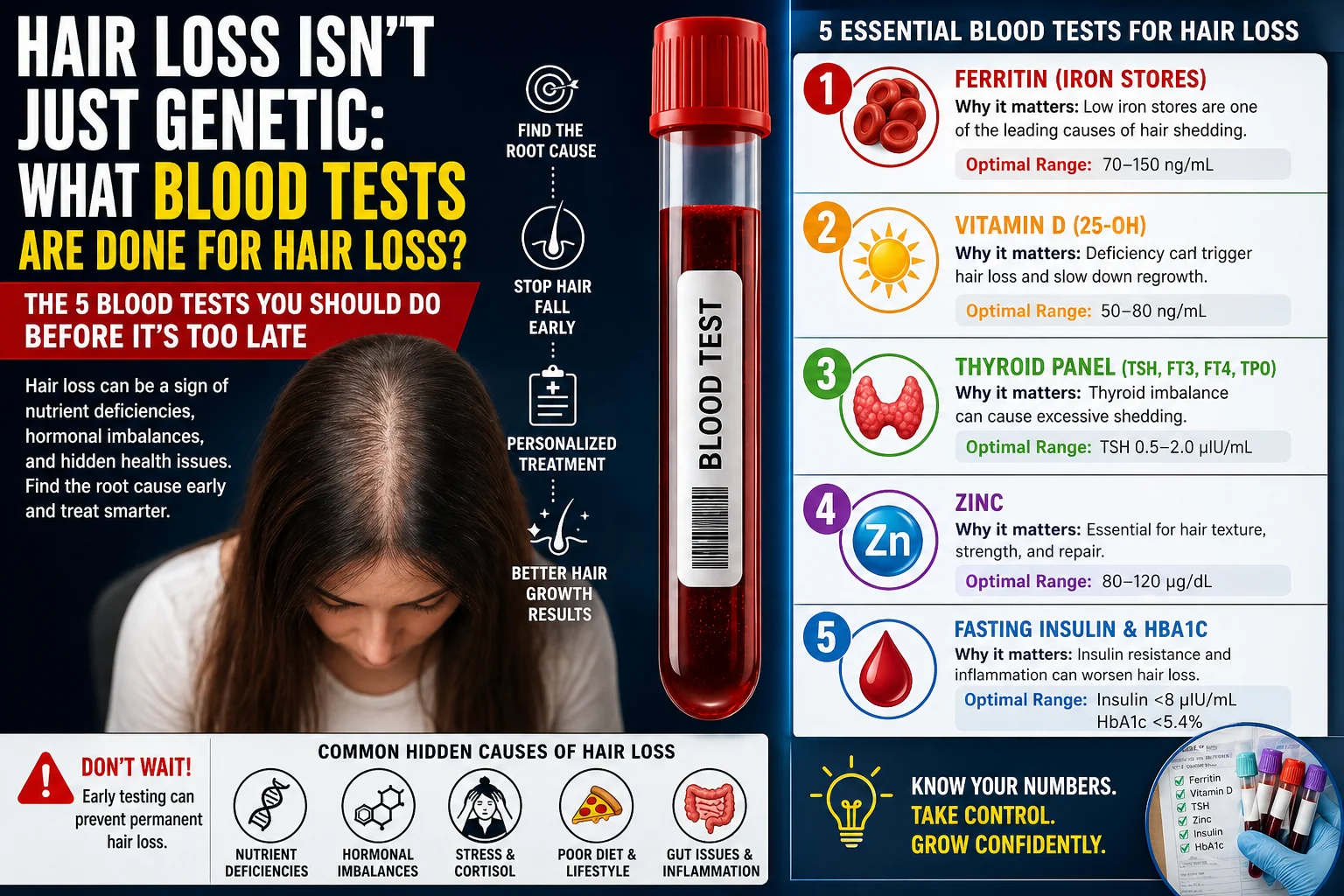
The most important blood tests for hair loss include ferritin (iron stores), vitamin D (25-OH), a full thyroid panel (TSH, Free T3, Free T4, TPO antibodies), zinc, and fasting insulin with HbA1c. These tests help identify common hidden causes of hair shedding such as nutrient deficiencies, hormonal imbalances, and insulin resistance. While lab results may fall within “normal” ranges, optimal levels for hair growth are typically higher—such as ferritin above 70 µg/L and vitamin D between 50–80 ng/mL. Testing these markers early allows you to treat the root cause of hair loss instead of relying only on topical products.
These markers reveal the root cause of hair loss, which topical treatments alone cannot fix
What your mirror won’t tell you—but your blood will.
Every morning, you see it: a few extra strands on the pillow, a clogged drain in the shower, or a widening part in the mirror. You immediately blame your father’s bald spot or your mother’s thinning crown. “It’s genetics,” you sigh. “There’s nothing I can do.”
But here is the uncomfortable truth: hair loss is rarely caused by a single factor.
While Androgenetic Alopecia (pattern baldness) is the most common diagnosis, it is often just the final straw on a camel already weakened by internal chaos. You can have the “baldness gene” and keep a full head of hair if your internal terrain is healthy. Conversely, you can have zero genetic predisposition and still lose half your volume due to a hidden metabolic disorder.
The tragedy? Hair follicles are non-renewable. Once a follicle miniaturizes and scars over (fibrosis), it is gone forever. However, before that point, most types of hair loss are reversible—if you catch the systemic cause early.
To do that, you don’t need a biopsy. You need a blood draw.
Here are the five blood tests you should demand today—before it’s too late to wake up the sleeping follicles.
The 5 Essential Blood Tests (At a Glance)
| Test | Optimal Level | What Happens If Low |
|---|---|---|
| Ferritin | 70–100 µg/L | Starved follicles, diffuse thinning |
| Vitamin D | 50–80 ng/mL | Premature shedding, patchy loss |
| Thyroid Panel | TSH 0.5–2.0 | Brittle, dry hair; eyebrow thinning |
| Zinc | 80–120 µg/dL | Weak shafts, white spots on nails |
| A1c & Fasting Insulin | A1c <5.4%; Insulin <8 µIU/mL | Scalp inflammation, DHT overload |
Note: Lab “normal” ranges are often too wide. Aim for the optimal ranges above.
1. Ferritin: The Silent Epidemic
Most doctors check for anemia using “Hemoglobin.” You can have perfect hemoglobin and be losing fistfuls of hair.
What it measures: Your body’s iron stores.
Why it matters: Hair matrix cells are among the fastest dividing cells in the body. They require massive amounts of energy. Iron is the spark plug for that energy.
The “Normal” Trap: Lab ranges say 20 µg/L is normal. For hair growth, you need ≥70 µg/L.
Loss profile: Diffuse thinning all over the scalp, no specific bald spot.
2. Vitamin D: The Sunlight Hormone
We used to think Vitamin D was just for bones. In fact, the hair follicle has its own Vitamin D receptors.
What it measures: 25-hydroxyvitamin D.
Why it matters: Vitamin D helps create new follicle shafts and regulates the hair cycle. Deficiency pushes massive numbers of follicles from growing (anagen) into shedding (telogen) simultaneously.
The Shock: Studies show that people with Alopecia Areata have severely low Vitamin D levels. Supplementing can regrow hair even when steroids fail.
Loss profile: Sudden, excessive shedding; circular bald patches.
3. Thyroid Panel: Not Just TSH
You’ve had your TSH checked. It came back normal. But you are tired, cold, and balding.
What it measures: TSH, Free T3, Free T4, and TPO Antibodies.
Why it matters: Thyroid hormones are the gas pedal for your metabolism. Both hyperthyroidism (too fast) and hypothyroidism (too slow) send hair into a resting state. Autoimmune thyroiditis (Hashimoto’s) often has normal TSH but high antibodies.
The Trap: Standard “normal” TSH (0.5–4.5) is too wide. Optimal for hair: TSH 0.5–2.0.
Loss profile: Rough, dry, brittle hair that breaks easily, plus thinning of the outer third of the eyebrow.
4. Zinc: The Follicle Builder
Zinc is the overlooked construction worker of the body. It is involved in DNA synthesis and protein production.
What it measures: Serum zinc.
Why it matters: The follicle uses zinc to bind the proteins that create the hair shaft. Without it, the shaft is weak and snaps before it even exits the scalp.
Why deficiency happens: High stress (cortisol depletes zinc), vegetarian diets (phytates block absorption), and gut issues (Crohn’s, celiac).
Loss profile: Dramatic shedding 2–3 months after a stressful event, plus brittle nails with white spots.
5. Hemoglobin A1c & Fasting Insulin: The Circulation Killers
You are not diabetic. You don’t need to look at blood sugar. Wrong.
What it measures: Average blood sugar over 90 days (A1c) and the storage hormone (Insulin).
Why it matters: High insulin creates chronic inflammation that clogs the micro-vessels feeding the scalp. It also raises DHT, the hormone that kills follicles in genetic balding.
The Reality: You can have a “perfect” A1c of 5.4% but sky-high fasting insulin due to a high-carb diet.
Loss profile: Thinning at the crown and frontal hairline; often combined with belly fat and skin tags.
How to Get These Tests Without a Doctor’s Fight
Do not simply walk into a GP’s office and recite this list. Most will refuse, saying, “These aren’t indicated for hair loss.”
Two reliable options:
- Direct-to-Consumer Labs (Best for most people)
Use Ulta Lab Tests, Jason Health, or Let’s Get Checked. You order the panel yourself, walk into a local phlebotomy center, and get results emailed within 48 hours. Cost: ~150–200 for all five tests. - The Doctor Script (If you want insurance coverage)
Say: “I have had diffuse hair loss for six months. Please rule out anemia, thyroid autoimmunity, and metabolic syndrome before I commit to lifelong minoxidil.”
📌 Reader’s Cheat Sheet: Do’s and Don’ts
✅ The Do’s (Proven to Help)
| Category | What to Do | Why |
|---|---|---|
| Testing | Test ferritin, vitamin D, thyroid, zinc, and insulin before buying any hair product | You cannot treat what you do not measure |
| Supplementation | Take iron (with vitamin C) if ferritin is low; take vitamin D3 with K2 and magnesium | Enhances absorption and prevents side effects |
| Diet | Eat 30g of protein at breakfast (eggs, Greek yogurt, collagen) | Hair is made of protein—feed it first thing |
| Scalp Care | Massage your scalp for 4 minutes daily | Increases blood flow to starving follicles |
| Stress Management | Prioritize 7–8 hours of sleep and morning sunlight | Lowers cortisol, which depletes zinc and ferritin |
| Medication | Consider topical minoxidil after fixing blood work | Drugs work better when the internal terrain is healthy |
❌ The Don’ts (Waste of Time & Money)
| Category | What to Avoid | Why It Backfires |
|---|---|---|
| Testing | Don’t rely on “normal” lab ranges without seeing the actual number | Labs flag only extreme deficiency; optimal is much higher |
| Supplements | Don’t take biotin before testing | Biotin interferes with thyroid and troponin assays (false results) |
| Diet | Don’t crash diet or cut calories drastically | Rapid weight loss triggers telogen effluvium 3 months later |
| Products | Don’t buy expensive “hair growth” shampoos with no active ingredients | Most are cosmetics, not drugs—no follicle penetration |
| Stress | Don’t ignore sleep deprivation | One bad night raises cortisol for 24 hours, suppressing follicle activity |
| Delay | Don’t wait 6 months to see if it “grows back on its own” | Every month of active shedding risks permanent miniaturization |
🚩 When to See a Specialist Immediately
See a dermatologist or trichologist within 4 weeks if you experience:
- Sudden patchy bald spots (possible alopecia areata or scarring alopecia)
- Pain, itching, or burning on the scalp (sign of inflammation or infection)
- Rapid shedding of >150 hairs per day for more than 2 months
- Hair loss with fatigue, joint pain, or facial rash (possible lupus or autoimmune disease)
Do not waste time with blood tests alone in these cases—you need a scalp biopsy.
1. Most important blood tests for hair loss (female)?
- Ferritin (iron stores)
- Vitamin D (25-OH)
- Thyroid panel (TSH, Free T3, Free T4, TPO antibodies)
- Zinc
- Fasting insulin + HbA1c
- Androgens (Testosterone, DHEAS for PCOS)
2. What tests determine hair loss?
- Blood tests (nutritional + hormonal)
- Scalp exam (dermatoscopy)
- Hair pull test
- Scalp biopsy (rare, severe cases)
3. Men hair loss blood test?
- Ferritin
- Vitamin D
- Thyroid panel
- Testosterone & DHT
- Fasting insulin / HbA1c
4. Hair loss test at home?
Yes:
- At-home blood kits (finger-prick or lab visit)
- Hair pull test (basic self-check)
5. Hair loss test kit?
Includes:
- Hormone panel
- Vitamin levels
- Sometimes cortisol & thyroid markers
6. Hair checkup—what does it include?
- Scalp analysis
- Hair density check
- Blood work
- Medical history review
7. Hair serum test?
No real “test.” Serums are treatments—not diagnostic tools. Effectiveness varies and doesn’t identify root cause.
8. What tests are done for female hair loss?
Same as above + PCOS-focused tests:
- LH/FSH ratio
- Prolactin
- Androgen panel
9. What is the “Big 3” for hair loss?
- Minoxidil (growth stimulant)
- Finasteride (DHT blocker, mainly men)
- Ketoconazole shampoo (anti-inflammatory/anti-fungal)
10. Can Malassezia cause hair loss?
Yes. It can cause:
- Dandruff / seborrheic dermatitis
- Scalp inflammation → temporary hair shedding
11. What blood tests detect hair loss?
No single test—combination:
- Ferritin
- Vitamin D
- Thyroid
- Zinc
- Insulin / glucose
- Hormones
12. What blood test is done for hair loss in men?
Same core panel:
- Ferritin
- Vitamin D
- Thyroid
- Testosterone / DHT
- Insulin
13. Can hair loss stop at Norwood 2?
Yes. With early treatment (lifestyle + medication), hair loss can stabilize and not progress further.
The Final Warning (No Sugarcoating)
Rogaine (minoxidil) and finasteride are excellent drugs for genetic hair loss. But they do not fix low ferritin, low thyroid, or high insulin. Using them without testing is like painting over moldy drywall. It looks better for a month, but the rot continues underneath.
Hair is a non-essential tissue to your body. If you are losing it, your body is screaming that something deeper is broken. Don’t just treat the mirror. Treat the blood.
About the Author
This article is based on clinical guidelines from the American Academy of Dermatology, the International Society of Hair Restoration Surgery, and peer-reviewed research on nutritional hair loss. Always consult your physician before starting new supplements or treatments.
Your follicles are waiting for you to look past your family tree.