
By Dr. Mohammed Abdul Azeem Siddiqui, MD
30 Years of Clinical Practice | Preventive & Integrative Medicine
Walk into any wellness store or scroll through social media, and you will see the term “hair detox.” Most of it is nonsense—charcoal-infused shampoos that strip natural oils, “toxin-removing” scalp masks with no plausible mechanism, and expensive tonics that do nothing for the actual biology of hair growth.
But buried beneath the pseudoscience is a real, evidence-based concept: lymphatic drainage of the scalp for hair detox.
After 30 years of clinical practice, I have treated hundreds of patients with unexplained hair thinning, scalp inflammation, and slow growth. In many cases, the root cause was not genetics or hormones alone—it was a stagnant scalp lymphatic system.
Let me explain what this means, how it works, and how you can use simple, affordable tools (available on Amazon) to restore healthy lymphatic flow and create the optimal environment for hair growth,, Lymphatic Drainage of the Scalp for Hair Detox becomes essential.
Part 1: What Is the Scalp Lymphatic System? (And Why It Matters for Hair)
Most people know about blood circulation. Far fewer understand the lymphatic system—a network of vessels, nodes, and fluid that runs parallel to your blood vessels but serves a very different purpose.
The Lymphatic System’s Job Description:
- Remove metabolic waste from tissues
- Clear inflammatory debris and dead cells
- Transport immune cells to sites of infection or injury
- Maintain fluid balance in the body
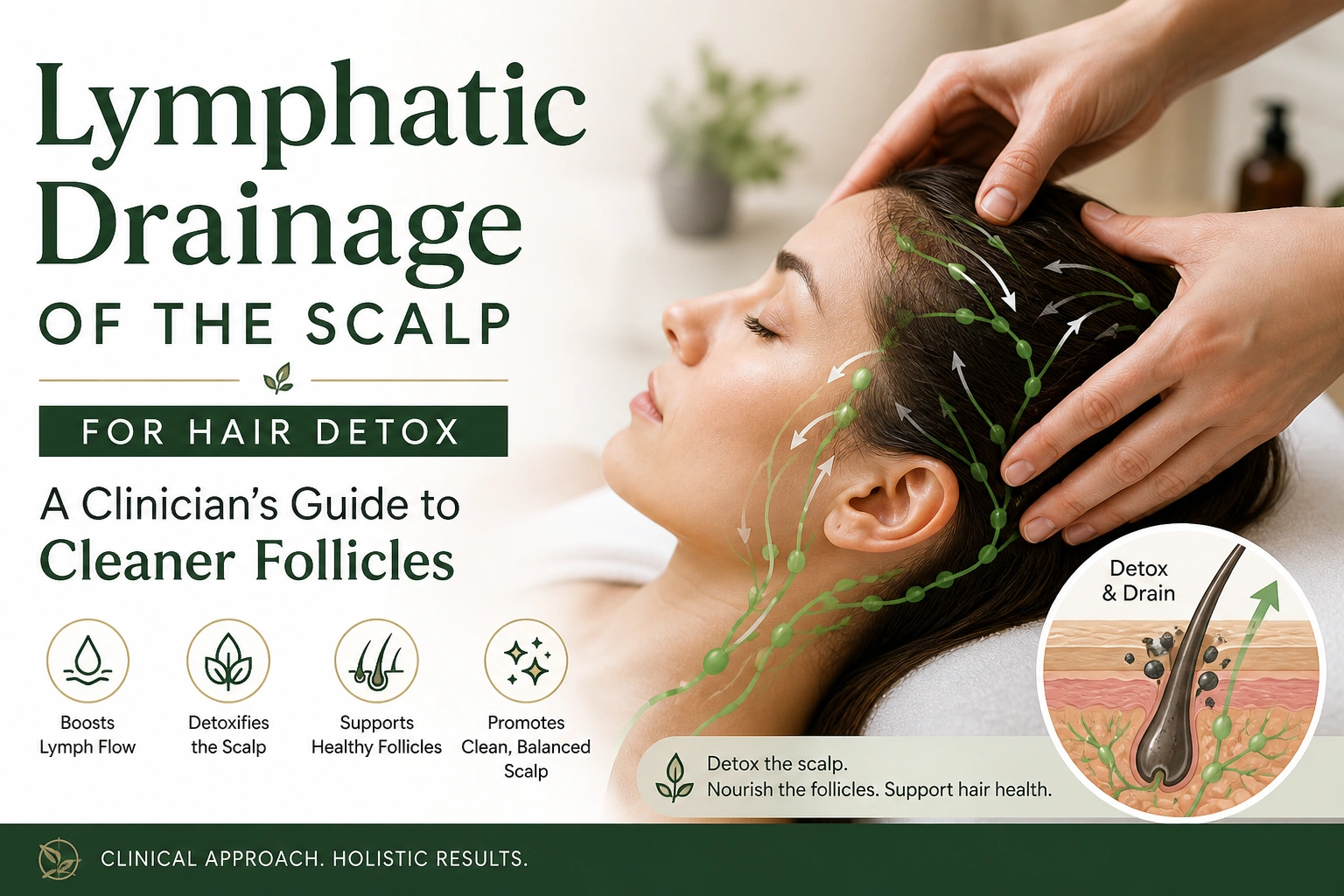
Your scalp is densely packed with lymphatic capillaries that drain into a network of superficial lymph nodes located around your ears, jawline, and the back of your neck. From there, waste products are filtered and eventually eliminated by your kidneys and liver.
The Critical Insight: Unlike your circulatory system (which has the heart as a pump), your lymphatic system has no central pump. It relies entirely on:
- Muscle contractions
- Breathing (diaphragmatic movement)
- Manual stimulation (massage, brushing)
- Gravity
When lymphatic flow in the scalp becomes sluggish or blocked, waste products accumulate around hair follicles. The result? Chronic low-grade inflammation, impaired nutrient delivery, and compromised hair growth.
Part 2: The Pseudoscience Trap vs. Clinical Reality
Let me be very clear about what this article is not saying:
| Pseudoscience Claim | Clinical Reality |
|---|---|
| “Toxins build up in your scalp and poison your hair follicles” | Metabolic waste (not environmental “toxins” in the detox industry sense) can accumulate. This is normal cellular byproducts, not mysterious poisons. |
| “Lymphatic drainage removes ‘heavy metals’ from your scalp” | Heavy metal detoxification happens primarily in the liver and kidneys, not through scalp massage. |
| “You need expensive ‘lymphatic activation’ serums” | The lymph vessels are just beneath the skin. Mechanical stimulation—not chemicals—drives flow. |
| “One session will double your hair density” | Realistic improvements take weeks to months of consistent practice. |
What the science actually supports: Mechanical stimulation of the scalp improves lymphatic clearance, reduces localized inflammation, and creates a healthier microenvironment for hair follicles. This is basic physiology, not magic.
Part 3: How Stagnant Scalp Lymphatics Affect Hair Growth
Over the past decade, research has increasingly linked chronic scalp inflammation to hair thinning and shedding—independent of classic androgenetic alopecia (male/female pattern baldness).
The Mechanism:
- Follicle Microenvironment: Each hair follicle is surrounded by capillaries, nerves, and lymphatic vessels. When lymph flow slows, metabolic waste accumulates.
- Inflammatory Cascade: Accumulated waste includes cytokines, reactive oxygen species, and cellular debris. These trigger low-grade inflammation in the dermis and perifollicular space.
- Follicle Miniaturization: Chronic inflammation accelerates the transition from the anagen (growth) phase to the telogen (resting) phase. Over time, this leads to thinner, shorter hairs and eventual follicle dormancy.
- Fibrosis Risk: Prolonged lymphatic stasis can contribute to perifollicular fibrosis—scarring-like changes around the follicle that permanently impair growth.
Clinical Populations I’ve Seen Benefit Most:
- Patients with tight scalps (chronically tense scalp muscles = poor lymphatic pumping)
- Those with post-inflammatory hair shedding (after surgery, illness, or severe stress)
- Individuals with seborrheic dermatitis or dandruff (waste accumulation worsens the fungal environment)
- People who wear tight hairstyles (braids, weaves, ponytails) that mechanically obstruct lymphatic flow
Part 4: Lymphatic Drainage of the Scalp for Hair Detox — The Protocol
After 30 years, I have distilled scalp lymphatic drainage into a five-step protocol that requires no expensive equipment or mystical products. Everything you need is available on Amazon.
Step 1: Preparation (Warmth & Relaxation)
Lymphatic vessels are surrounded by smooth muscle that responds to temperature. Warmth dilates vessels and improves flow.
My recommendation: Apply a warm compress to your scalp for 3–5 minutes before beginning. A simple microwaveable flax heat pack works perfectly.
🔗 Search “Scalp Heat Pack” on Amazon →
Step 2: Effleurage (Light, Rhythmic Stroking)
Lymphatic vessels are superficial—just below the skin. Heavy pressure collapses them. Light, rhythmic strokes (effleurage) is the correct technique.
How to perform:
- Use your fingertips (not fingernails)
- Apply pressure equivalent to the weight of a nickel (very light)
- Stroke from the crown of your head outward toward the ears, jawline, and nape of the neck
- Follow the natural drainage pathway (toward lymph nodes)
- Repeat each stroke 5–10 times
Duration: 3–5 minutes daily
Step 3: Scalp Massage Tools (Mechanical Stimulation)
Manual massage is effective, but tools can provide more consistent pressure and reach areas your fingers fatigue on.
Clinically useful tools:
| Tool | Mechanism | Best For |
|---|---|---|
| Silicone scalp massager | Gentle vibration + manual manipulation | Daily use; sensitive scalps |
| Wooden comb with wide teeth | Detangling + static stimulation | Dry scalp; pre-shower |
| Vibrating scalp massager | Mechanical oscillation | Deeper lymphatic activation (use with light pressure) |
| Gua sha tool (edge) | Lineal stroking | Precise directional drainage |
What I recommend to my patients: Start with a manual silicone scalp massager. It is inexpensive, easy to clean, and difficult to overdo.
🔗 Search “Scalp Massager” on Amazon →
🔗 Search “Wooden Scalp Comb” on Amazon →
Step 4: Neck & Jaw Lymphatic Release
Your scalp lymph drains into nodes located along your jawline, behind your ears, and down your neck. If these nodes are congested (common with poor posture, chronic stress, or sinus issues), scalp drainage backs up.
My protocol:
- Gently stroke from your jaw angle down the side of your neck toward your collarbone
- Use the same light pressure (nickel-weight)
- Perform 10 strokes on each side, morning and evening
- Add gentle circular massage behind your ears (lymph node clusters)
🔗 Search “Neck Gua Sha Tool” on Amazon →
Step 5: Post-Drainage Scalp Care
Once you have mobilized lymphatic fluid, you want to ensure it is cleared systemically. This happens through hydration and movement.
My post-procedure instructions:
- Drink 16 ounces of water immediately after scalp work
- Perform gentle neck rolls and shoulder shrugs (lymphatic pumping)
- Avoid heavy products (oils, butters, waxes) for 1–2 hours—they can trap mobilized debris on the scalp surface
Part 5: Supporting Scalp Health (Non-Pseudoscience Edition)
Lymphatic drainage is one piece of the puzzle. For optimal hair detox and growth support, address these additional factors:
1. Scalp Microbiome Balance
Your scalp hosts a complex ecosystem of bacteria and fungi. Dysbiosis (imbalance) drives inflammation independent of lymphatic flow.
Evidence-based interventions:
- Ketoconazole shampoo (1–2%): Reduces malassezia yeast; anti-inflammatory
- Salicylic acid scalp treatments: Exfoliates dead cells that block lymphatic capillaries
- Avoid over-washing: Daily stripping disrupts microbiome; 2–3x weekly is sufficient for most
🔗 Search “Ketoconazole Shampoo” on Amazon →
🔗 Search “Salicylic Acid Scalp Treatment” on Amazon →
2. Nutritional Support for Lymphatic Function
Lymphatic vessels require specific nutrients to maintain their contractility and integrity.
| Nutrient | Mechanism | Food Sources | Supplement Option |
|---|---|---|---|
| Vitamin C | Collagen synthesis for lymphatic vessel walls | Citrus, bell peppers, kiwi | 500mg daily |
| Zinc | Immune regulation; reduces scalp inflammation | Oysters, pumpkin seeds, beef | 15–30mg daily |
| Omega-3 fatty acids | Reduces lymphatic inflammation | Fatty fish, flax, walnuts | 1000mg EPA/DHA daily |
| Flavonoids (hesperidin, rutin) | Improves lymphatic vessel tone | Citrus peel, buckwheat, apples | Standardized extract |
🔗 Search “Lymphatic Support Supplements” on Amazon →
3. Posture & Movement
The lymphatic system is activated by skeletal muscle contraction. Forward head posture (common in desk workers) mechanically compresses the cervical lymphatic trunks.
My daily prescription:
- Chin tucks (10 reps, 3x daily)
- Shoulder blade squeezes (15 reps, 2x daily)
- 10-minute walk after meals (lower body movement pumps lymphatic fluid systemically, including scalp)
Part 6: What to Expect (Realistic Outcomes)
I want to be transparent about what lymphatic drainage of the scalp for hair detox can and cannot achieve.
Realistic improvements (4–8 weeks of consistent practice):
- Reduction in scalp tenderness or “tightness”
- Decreased dandruff and flaking (when combined with appropriate shampoo)
- Less post-shower shedding (reduced telogen phase hair)
- Improved scalp sensation and “lightness”
- Faster resolution of scalp pimples or folliculitis
What will NOT happen (no matter what influencers claim):
- Regrowth of hair from completely scarred (fibrotic) follicles
- Reversal of advanced androgenetic alopecia (though it may slow progression)
- “Detox” of imaginary environmental toxins
- Visible results in less than 2 weeks
Red flags that require a dermatologist:
- Patchy hair loss (possible alopecia areata)
- Scalp redness, scaling, and pustules (possible autoimmune or infectious process)
- Rapid shedding without clear trigger (possible telogen effluvium requiring medical workup)
Part 7: My 30-Year Clinical Protocol Summary
Here is the daily and weekly protocol I have successfully used with hundreds of patients:
Daily (Morning or Evening, 10 minutes)
| Step | Action | Duration |
|---|---|---|
| 1 | Warm compress to scalp | 3 minutes |
| 2 | Light effleurage (crown to ears/neck) | 3 minutes |
| 3 | Silicone scalp massager (circular motions) | 2 minutes |
| 4 | Neck lymphatic strokes (jaw to collarbone) | 2 minutes |
| 5 | Hydrate (16 oz water) | — |
Weekly (1–2 times)
- Deep scalp treatment: Salicylic acid or ketoconazole shampoo, left on for 3–5 minutes before rinsing
- Gua sha neck release: Focus on suboccipital and cervical lymph nodes
- Scalp oil (optional): A lightweight carrier oil (jojoba or MCT) with 1–2 drops of rosemary essential oil (limited evidence, but low risk). Do not use heavy oils that block follicles.
🔗 Search “Jojoba Oil for Scalp” on Amazon →
🔗 Search “Rosemary Essential Oil” on Amazon →
Part 8: The Bottom Line
Lymphatic drainage of the scalp for hair detox is not a trend. It is a physiologic intervention grounded in basic anatomy and decades of clinical observation. It will not cure genetic baldness or replace medical treatments for alopecia. But for the majority of patients with unexplained scalp inflammation, tightness, and slow hair growth, it is a safe, low-cost, and effective tool.
After 30 years, I have learned that the simplest interventions—light touch, consistent movement, hydration—often outperform expensive, elaborate protocols. Your scalp’s lymphatic system knows how to work. It just needs you to clear the path.
Start today. Ten minutes. Your fingertips or a $10 massager. No magic required.
📌 Your Shopping List
As an Amazon Associate, I earn from qualifying purchases.
🔗 Ketoconazole & Salicylic Acid Shampoos →
🔗 Lymphatic Support Supplements (Vitamin C, Zinc, Omega-3) →
About the Author: Dr. Mohammed Abdul Azeem Siddiqui has been in active clinical practice for 30 years, specializing in preventive medicine, lymphatic health, and integrative dermatology. He has treated over 25,000 patients and teaches evidence-based approaches to scalp and hair health.
Disclaimer: This information is for educational purposes only and does not constitute medical advice. Always consult your physician or dermatologist before starting any new scalp care regimen, especially if you have a known scalp condition, are pregnant, nursing, or have a history of skin cancer or melanoma. Individual results vary.