
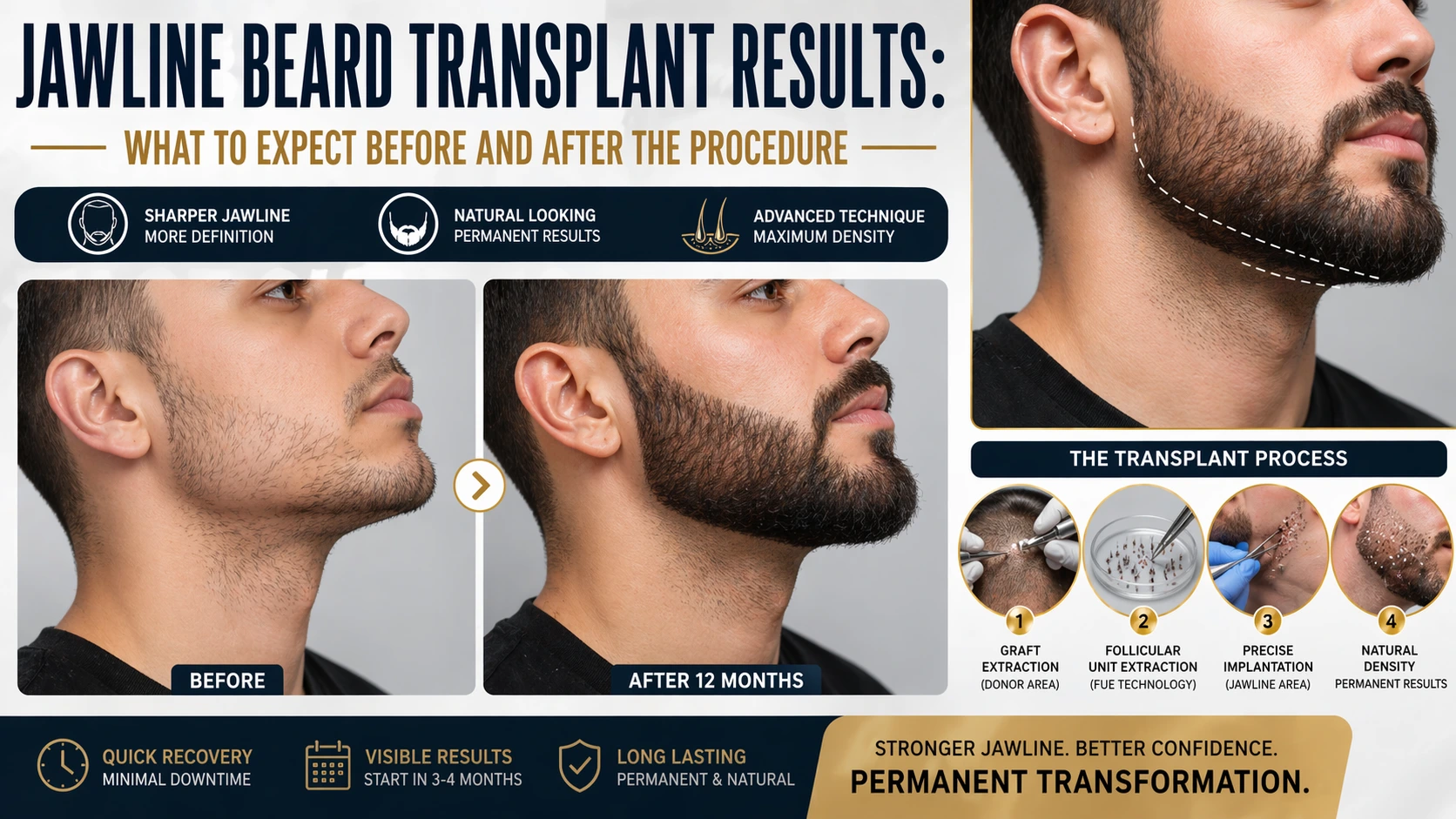

A sharp, defined jawline is often associated with youth, masculinity, and confidence. But what if you have the bone structure of a movie star—yet your beard refuses to cooperate? and you want a Jawline Beard Transplant?
A jawline beard transplant is one of the most popular facial hair restoration procedures for men who want a sharp, defined beard outline along the jaw. This style emphasizes the jaw structure and creates a masculine, well-groomed appearance. Many men choose this procedure when they have patchy beard growth or weak beard density along the jawline.
If you are tired of filling in gaps with pencils or living with a neckline that looks undefined, this guide will walk you through jawline beard transplant results—from the initial consultation to the final, permanent outcome.
Related Reading: Curious about other face shapes? Check out our guide on the Best Beard Styles for Different Face Shapes to see which jawline style suits your anatomy.
What Is a Jawline Beard Transplant?
A jawline beard transplant is a cosmetic procedure where hair follicles are taken from a donor area (usually the back of the scalp) and implanted along the jawline to create a fuller beard.
Unlike a full beard transplant, which covers the cheeks, chin, and neck, the jawline transplant targets the border from the sideburn to the chin.
The goal is to achieve:
- A strong beard outline
- Even hair density
- A natural facial hair pattern
This procedure is commonly performed using minimally invasive techniques, allowing surgeons to place follicles with high precision. The result is a “sculpted” line that mimics the natural shadow of a heavy stubble or a defined short beard—ideal for men who want a permanent 5 o’clock shadow without daily maintenance.
Modern Technique: Follicular Unit Extraction (FUE)
Modern techniques such as Follicular Unit Extraction allow surgeons to transplant individual hair follicles into precise areas along the jawline, producing natural-looking results.
Here is how FUE works:
- Donor Extraction: Individual follicular units (1-4 hairs each) are extracted from a donor area—usually the back or sides of the scalp—using micro punches.
- Graft Preparation: The follicles are carefully dissected under a microscope.
- Recipient Site Creation: Tiny incisions are made along the jawline at specific angles to mimic natural beard growth.
- Implantation: The follicles are placed one by one into these incisions.
Because FUE leaves no linear scar, patients can wear their hair short without visible evidence of surgery.
Who Is a Good Candidate for a Jawline Beard Transplant?
You may benefit from a jawline beard transplant if you have:
- Patchy beard growth
- Thin beard density along the jaw
- Scars preventing beard growth (from injury or previous surgery)
- Uneven beard patterns
Many men genetically struggle with beard growth due to hormonal sensitivity to androgens such as Dihydrotestosterone (DHT) , which plays a major role in facial hair development. Even if you have high testosterone, your hair follicles may simply not respond to DHT—leaving you with gaps exactly where you want density most.
You are a good candidate if:
- You have a strong jawbone but weak facial hair.
- You want a permanent, low-maintenance stubble or defined edge.
- You have adequate donor hair on your scalp.
- You have realistic expectations (shedding, 12-month timeline).
You may want to wait if:
- You are under 25 (beard patterns still developing).
- You smoke heavily (reduces graft survival).
- You expect immediate, full growth after 1 month.
Jawline Beard Transplant Procedure: Step-by-Step
The procedure typically involves several steps and lasts between 4 to 8 hours under local anesthesia.
Step 1: Consultation
The surgeon examines:
- Beard growth pattern
- Donor hair density
- Facial structure
The ideal jawline beard design is then mapped. Your surgeon will discuss your desired style—whether you want a soft stubble line or a hard, dense edge.
Step 2: Donor Hair Extraction
Hair follicles are extracted from the scalp using micro punches during the Follicular Unit Extraction (FUE) procedure.
These follicles usually contain 1–3 hairs each, which helps create natural beard density. The donor area is typically the back or sides of the head, where hair is genetically resistant to falling out.
Step 3: Graft Implantation
Tiny incisions are made along the jawline, and the follicles are implanted carefully at the correct angle to mimic natural beard growth.
A typical jawline beard transplant requires:
400–800 grafts
depending on density goals. For reference:
- Light stubble/jaw shadow: 400–600 grafts
- Defined, dense jawline (1-2cm wide): 600–1,200 grafts
- Full jaw-to-chin connection: 1,200–1,800 grafts
Internal Link: For those considering a full beard, learn how many Beard Transplant Grafts Needed for different styles, from stubble to lumberjack.
Jawline Beard Transplant Results Timeline
Understanding the growth timeline helps manage expectations. Jawline beard transplant results unfold in distinct phases over 12-18 months.
| Time Period | What to Expect |
|---|---|
| Week 1 | Mild redness and swelling; small scabs around grafts |
| Week 2–3 | Transplanted hairs begin to shed (shock loss) |
| Month 3–4 | New beard hairs begin growing (fine, soft texture) |
| Month 6 | Noticeable beard density appears (60-70% of final) |
| Month 12 | Full results become visible |
| Month 18 | Maximum density and maturity |
Detailed Breakdown
Days 1-10: The Healing Phase
- What you see: Redness, tiny scabs, mild swelling.
- What to do: Sleep with head elevated. Apply antibiotic ointment. Do not touch or pick at scabs.
- Can you shave? No. Wait 10-14 days.
Weeks 2-4: The Shedding Phase (Shock Loss)
- What you see: The transplanted hairs fall out. This is normal and expected.
- Why it happens: The hair follicle enters a “resting phase” after trauma. The root remains alive under the skin.
- Emotional note: Many men panic here. Do not. Shedding is a sign of success.
Months 3-6: The Growth Phase Begins
- What you see: Fine, soft hairs emerge along the jawline.
- Texture: Initially, the hair may feel thin or “peach fuzz”-like.
- What to do: You can trim gently after month 4. Do not shave flush to the skin yet.
Months 6-12: Noticeable to Full Density
- What you see: The jawline becomes visible as a distinct beard line. Hairs thicken and darken.
- Final result: At month 12, the beard looks natural because the transplanted follicles continue to grow like normal facial hair.
Jawline Beard Transplant Before and After
Most patients see dramatic improvement.
Before the Procedure (Typical Candidate)
- Patchy or thin hair along the jawline
- Undefined jawline with soft neckline
- Uneven facial hair patterns
- Inability to grow a 5 o’clock shadow
After the Procedure (12 Months)
- Defined beard outline that frames the face
- Thicker hair density along the entire jaw
- Stronger facial structure appearance
- Natural angle: Hairs lie flat against the skin, not sticking out
Because beard hair frames the lower face, the procedure can significantly improve facial symmetry and enhance the appearance of the jawline and chin—even when clean-shaven.
Realistic vs. Unrealistic Expectations
| Realistic | Unrealistic |
|---|---|
| A defined jawline border that looks natural | A beard that grows 2 inches long in 3 months |
| Permanent results that last a lifetime | Zero shedding (all transplants shed initially) |
| Matches your natural hair color/texture | Changes your bone structure (it enhances, not creates, a jaw) |
Benefits of a Jawline Beard Transplant
Strong Jaw Definition
A defined beard can enhance the appearance of the jawline and chin, creating a more chiseled, masculine profile.
Permanent Results
Transplanted hair follicles are permanent and continue to grow naturally for a lifetime. Unlike temporary solutions (beard fibers, minoxidil), a transplant is a one-time procedure.
Natural Appearance
Because surgeons implant individual follicular units at precise angles, the beard appears authentic—indistinguishable from natural facial hair.
Low Maintenance
After full growth, the beard can be trimmed, shaved, and styled normally. You can maintain a permanent stubble by shaving every 2-3 days, and the shadow will remain.
Jawline Beard Transplant Cost
Costs vary depending on:
- Number of grafts
- Clinic reputation
- Surgeon expertise
- Geographic location
Typical price ranges:
| Location | Estimated Cost (400-800 grafts) |
|---|---|
| United States | $4,000 – $9,000 |
| United Kingdom | £3,000 – £7,000 |
| Turkey / Eastern Europe | $1,500 – $3,500 |
The procedure is usually considered cosmetic and may not be covered by insurance. However, many clinics offer financing plans.
Is It Worth It?
For men who struggle with patchy jawline growth, the psychological boost of a permanent, defined jawline is often priceless. Unlike minoxidil (which requires daily application and stops working when you stop), a transplant is a one-time investment.
Recovery Tips: How to Maximize Your Results
Proper recovery ensures the best jawline beard transplant results.
First 10 Days (Critical Healing)
- Avoid touching transplanted grafts (this can dislodge follicles).
- Sleep with head elevated during the first week to reduce swelling.
- No gym, sweating, or heavy lifting for 10 days (sweat can infect or dislodge grafts).
- Avoid direct sun for 4 weeks (UV kills new follicles).
First 2 Weeks
- Avoid shaving for about 10–14 days.
- Follow surgeon’s aftercare instructions regarding washing (usually gentle saline spray).
- Do not pick at scabs—let them fall off naturally.
Months 1-3
- No harsh chemicals or beard dyes.
- Use a soft beard brush after month 2 to train growth direction.
- Avoid razors until month 3 (electric trimmer only).
Months 3-12
- Exfoliate gently to prevent ingrown hairs.
- Trim regularly to keep the jawline crisp.
- Be patient—density increases steadily.
Risks and Side Effects
Common (Resolve in 1-2 weeks)
- Swelling (may move down to eyes)
- Redness around grafts
- Mild itching (do not scratch)
Rare but Possible
- Infection (prevented with antibiotics)
- Ingrown hairs (exfoliate after month 3)
- Unnatural angle or direction (choose an experienced surgeon)
- Shock loss of existing beard hair (temporary)
How to Minimize Risks
- Choose a board-certified hair restoration surgeon who specializes in FUE beard transplants.
- Follow all pre-op and post-op instructions.
- Disclose all medications and health conditions during consultation.
FAQ: Jawline Beard Transplant Results
Q1: Will the transplanted hair look like natural beard hair?
A: Yes. When performed by an expert, the angle, direction, and density mimic natural beard growth. However, scalp hair may curl differently than beard hair initially (it usually adapts by month 12).
Q2: Can I shave completely after a jawline transplant?
A: Absolutely. Once healed (after 2-3 weeks), you can shave with a razor. The hair will grow back. In fact, many men shave clean to show off the “shadow” of the jawline.
Q3: How long until I see the final jawline beard transplant results?
A: Full results take 12-18 months. You will see visible improvement by month 6, but patience is required for maximum density.
Q4: Will the procedure leave scars on my face?
A: No. The recipient sites (jawline) heal with no visible scarring. The donor area (scalp) leaves tiny white dots that are undetectable even with a #2 buzz cut.
Q5: Can I combine a jawline transplant with a full beard transplant?
A: Yes. Many men start with a jawline to define the border, then later fill in the cheeks. Discuss a staged plan with your surgeon.
Q6: Is the procedure painful?
A: Local anesthesia numbs the area completely. You may feel pressure but not sharp pain. Some soreness occurs afterward, manageable with over-the-counter pain relievers.
Q7: Will the transplanted hair fall out like my original beard hair?
A: No. Transplanted follicles are taken from the scalp’s DHT-resistant donor area. They will not fall out due to hormonal changes, making the results permanent.
Final Takeaway: Is a Jawline Beard Transplant Right for You?
If you have a strong jawbone but weak facial hair, a jawline beard transplant can be life-changing. Modern techniques such as Follicular Unit Extraction allow surgeons to transplant individual hair follicles into precise areas along the jawline, producing natural-looking results.
You are a good candidate if:
- You have patchy or thin growth along your jaw.
- You want a permanent, low-maintenance stubble or defined edge.
- You have adequate donor hair on your scalp.
- You have realistic expectations (shedding, 12-month timeline).
The final beard looks natural because the transplanted follicles continue to grow like normal facial hair. With proper recovery and patience, you can wake up every day to a sharp, masculine beard line that frames your face permanently.
Next Steps
Ready to explore your options?
- Book a consultation with a board-certified hair restoration surgeon who specializes in FUE beard transplants.
- Bring photos of your desired jawline style (e.g., Henry Cavill’s stubble, Idris Elba’s edge).
- Ask the surgeon: “How many grafts will I need for my specific jawline?” and “Can I see jawline beard transplant results from previous patients?”
Your perfect jawline is not a matter of genetics anymore—it is a matter of surgical precision. With the right planning and patience, you can achieve the defined, masculine beard outline you have always wanted.
Related: Once you have your jawline perfected, explore the Best Beard Styles for Different Face Shapes to style your new hair for round, oval, or square faces, and learn exactly how many Beard Transplant Grafts Needed for your ideal look.
Jawline Beard Transplant Cost
Target keyword: jawline beard transplant cost
Explain average pricing:
- 500 grafts → $2,000–$4,000
- 1,000 grafts → $4,000–$7,000
- 3,000 grafts → $10,000–$18,000 in the USA
Beard Transplant Cost
Target keyword: beard transplant cost
Discuss factors:
- clinic reputation
- surgeon experience
- graft count
- location
Jawline Beard Transplant Before and After
Target keyword: jawline beard transplant before and after
Use image-heavy content.
Jawline Beard Transplant Near Me
“best jawline beard transplant in New York City”
“best beard transplant clinic in Los Angeles”
Beard Transplant Side Effects
Target keyword: beard transplant side effects
Common side effects:
- swelling
- redness
- itching
- temporary shedding
Beard Transplant Surgery
beard transplant surgery
Explain procedure:
Often performed using Follicular Unit Extraction.
Beard Transplant Near Me
Target keyword: beard transplant near me
Local SEO section.
What Is the 3-Month Beard Rule?
This usually means:
Grow your beard naturally for 3 months before deciding its full potential.
This helps determine whether surgery is needed.
Is It Okay to Masturbate After a Hair Transplant?
Common post-op advice:
Avoid activities that increase blood pressure for 3–7 days, as excessive sweating or increased circulation may affect healing.
How Much Do 3,000 Hair Grafts Cost in the USA?
Average cost:
$10,000–$18,000 depending on clinic and city.
Can a Beard Improve Jawline?
Yes.
A well-designed beard can create:
- stronger chin appearance
- sharper jawline
- slimmer face illusion