
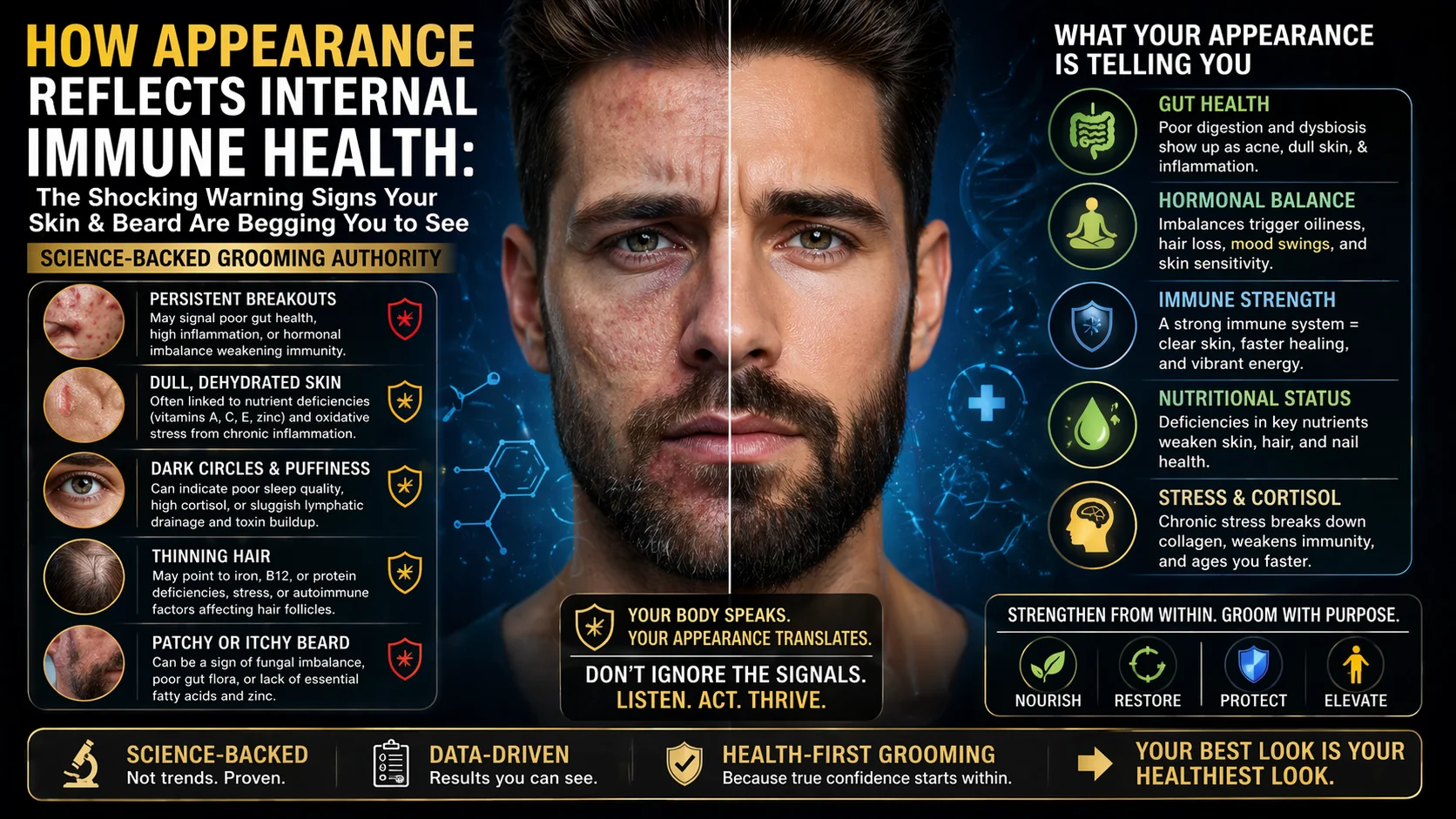

Your face is not just a canvas for expression—it is a diagnostic window into your immune system.
Every morning, when you look in the mirror, you are seeing more than just your reflection. You are observing a real-time report card of your internal health. That stubborn acne, that patchy beard, that unexplained redness or dullness—these are not random cosmetic inconveniences. They are signals. Messages from your immune system trying to tell you something about what is happening beneath the surface.
As the science-backed grooming authority for skin, beard, and immune health, we have analyzed decades of dermatological and immunological research to answer one critical question: how appearance reflects internal immune health—and what you can do about it.
The Immune-Skin Connection: Why Your Face Tells the Truth
Your skin is your body’s largest organ and the frontline defense of your immune system. It contains its own specialized immune cells—Langerhans cells, T-cells, and mast cells—that constantly monitor for threats. When your internal immune system is balanced, your skin reflects that balance with clarity, even tone, and resilience. When your immune system is stressed, inflamed, or suppressed, your skin becomes the first place symptoms appear.
Dr. Jessica Wu, a board-certified dermatologist, explains it simply: “The skin is a mirror of the immune system. If something is off internally, the skin will often show it before blood tests do.”
5 Visible Signs Your Immune Health Needs Attention
Here is how your appearance communicates with you daily:
1. Recurring Cold Sores or Fever Blisters
- What you see: Painful blisters around the lips or mouth
- What it means: The herpes simplex virus lives dormant in your nerves. A healthy immune system keeps it suppressed. When you see a breakout, your immune system is temporarily weakened—often due to stress, lack of sleep, or illness.
- Action step: Prioritize sleep, reduce stress, and consider lysine supplementation.
2. Persistent Acne That Won’t Respond to Topicals
- What you see: Cystic, inflamed acne along the jawline, chin, and cheeks
- What it means: This pattern often signals systemic inflammation or hormonal imbalance. Your immune system may be overreacting to bacteria or sebum, creating excessive inflammation.
- Action step: Look beyond skincare. Address gut health, blood sugar stability, and stress hormones.
3. Sudden Hair Thinning or Patchy Beard Growth
- What you see: Circular bald patches (alopecia areata) or generalized thinning
- What it means: Alopecia areata is an autoimmune condition where immune cells attack hair follicles. Generalized thinning can indicate chronic low-grade inflammation or nutritional deficiencies affecting immune function.
- Action step: See a dermatologist for autoimmune screening. Check ferritin, vitamin D, and zinc levels.
4. Chronically Dry, Flaky, or Red Skin
- What you see: Persistent redness, scaling, or irritation (often mislabeled as “just dry skin”)
- What it means: Conditions like seborrheic dermatitis and psoriasis are driven by immune dysfunction. Your immune system is overreacting to yeast that naturally lives on your skin or attacking healthy skin cells.
- Action step: Avoid harsh exfoliants. Look for anti-inflammatory ingredients like niacinamide and colloidal oatmeal.
5. Slow-Healing Cuts or Razor Bumps That Get Infected
- What you see: Minor nicks from shaving that take weeks to heal or frequently become infected
- What it means: This is a red flag for immune suppression. A healthy immune system closes small wounds within days. Delayed healing suggests your immune cells are not responding effectively.
- Action step: Consult a physician. This can be associated with diabetes, nutritional deficiencies, or chronic stress.
The Beard-Immune Connection: What Facial Hair Reveals
As the science-backed grooming authority for skin, beard, and immune health, we cannot ignore the unique relationship between beard growth and immune function.
Your beard follicles are immunologically active sites. Each follicle is surrounded by immune cells that protect against bacterial and fungal invaders. When your immune system is thriving, your beard grows consistently, the skin beneath remains healthy, and ingrown hairs are rare. When immune health declines, you may notice:
| Beard Symptom | Possible Immune Link |
|---|---|
| Patchy, sudden hair loss | Autoimmune attack on follicles (alopecia areata) |
| Persistent beard dandruff (seborrheic dermatitis) | Immune overreaction to Malassezia yeast |
| Recurring folliculitis (infected hair follicles) | Impaired immune defense against bacteria like Staph |
| Slow beard growth despite good genetics | Chronic low-grade inflammation diverting resources |
The takeaway is clear: a healthy beard requires a healthy immune system first. No oil or balm can compensate for internal dysfunction.
How to Support Both Your Immune System and Your Appearance
The good news is that the same habits that improve your internal immune health will directly improve your skin and beard. Here is your science-backed action plan:
1. Prioritize Sleep (7–9 Hours)
Sleep is when your immune system releases cytokines—proteins that fight infection and inflammation. Chronic sleep deprivation elevates cortisol, which suppresses immune function and triggers acne, hair thinning, and slow wound healing.
2. Manage Stress Intentionally
Chronic stress keeps your body in a pro-inflammatory state. This worsens acne, psoriasis, eczema, and alopecia. Incorporate daily stress management—whether meditation, exercise, or simply five minutes of deep breathing.
3. Eat for Immune Resilience
Focus on:
- Zinc (seafood, pumpkin seeds, chickpeas) – critical for immune cell function and hair growth
- Vitamin D (sunlight, fatty fish, supplements) – low levels are directly linked to autoimmune conditions
- Omega-3 fatty acids (salmon, walnuts, flaxseeds) – reduce systemic inflammation
- Probiotics (yogurt, kimchi, sauerkraut) – support the gut-immune-skin axis
4. Build a Skin Barrier-Supporting Routine
Your topical routine should work with your immune system, not against it:
- Gentle cleanser (no sulfates or physical scrubs)
- Niacinamide – calms immune overreaction in the skin
- Ceramides – restore physical barrier function
- Mineral SPF 30+ daily – UV radiation suppresses local immune function in the skin
5. Know When to See a Doctor
If your skin or beard symptoms persist despite lifestyle changes, seek professional help. Autoimmune conditions like lupus, psoriasis, and alopecia areata require medical management. Blood tests can reveal hidden deficiencies or inflammatory markers.
Final Verdict: Your Appearance Is Your Immune System’s Messenger
The question how appearance reflects internal immune health is not a philosophical one—it is a clinical, observable, and actionable reality. Your skin and beard are not separate from your body. They are extensions of your immune system, visible to the naked eye.
As the science-backed grooming authority for skin, beard, and immune health, our message is simple: stop treating symptoms without understanding their cause. That persistent breakout, that patch of thinning beard, that slow-healing razor bump—these are not cosmetic failures. They are conversations. Listen to them.
When you nourish your immune system with sleep, nutrition, stress management, and gentle topical support, your appearance will reward you. Not with perfection, but with resilience. With clarity. With the honest reflection of a body that is fighting for you every single day.Frequently Asked Questions: Immune Health, Appearance, and Skin
Here are science-backed answers to the most common questions about how your immune system connects to your looks, eyes, skin, and overall health.
Do attractive people have stronger immune systems?
The short answer is: possibly, but the relationship is more complex than “attractive = healthy immune system.”
A 2022 study published in Scientific Reports investigated this exact question. Researchers activated the immune systems of healthy men through vaccination (against hepatitis A/B and meningococcus) and measured their antibody levels—a direct marker of immune reactivity. They then had women rate the men’s facial attractiveness from photographs .
The finding: There was no significant association between antibody levels and perceived facial attractiveness. Men who mounted stronger immune responses were not rated as more attractive .
However, other research tells a slightly different story. A study published in the British Royal Society Journal B found that people rated as more attractive tended to have stronger immune function in certain specific ways—particularly in their ability to kill bacteria (antibacterial immunity). This study involved 159 participants and 492 raters .
Another study from 2024 linked attractiveness to longevity. Researchers found that people rated lowest in attractiveness had a 17% higher risk of death, with the least attractive men living about 1 year less and women about 2 years less than their more attractive counterparts .
The bottom line: While some studies show a correlation between attractiveness and certain immune markers, the evidence is mixed. A strong immune system alone does not guarantee you’ll be perceived as attractive. Other factors—including skin clarity, facial symmetry, body language, and cultural standards—play major roles in attractiveness judgments .
Is it true that when your immune system finds your eyes?
No—this is a common myth that grossly exaggerates a real but rare medical condition.
The truth is more nuanced. Your eyes are what scientists call “immune-privileged organs.” This doesn’t mean your immune system doesn’t know your eyes exist. Rather, it means your eyes have special mechanisms that dampen immune responses to protect your vision .
Here’s what actually happens:
- Your eyes DO contain immune cells. They have macrophages, specialized immune cells, and can recruit additional immune cells from your bloodstream when needed .
- Your eyes lack lymphatic vessels and have reduced blood vessel density in certain areas (like the cornea). This helps minimize inflammation that could cloud your vision .
The myth originates from a real condition called sympathetic ophthalmia (also known as “sympathetic eye”). This is a rare autoimmune reaction that can occur after one eye suffers a severe penetrating injury. When the injured eye leaks internal proteins into the bloodstream, your immune system may recognize these proteins as “foreign” (because they were hidden during immune system development) and mount an attack that affects both eyes .
But this is extremely rare:
- Only about 0.2% to 0.5% of non-surgical eye injuries trigger this reaction
- Less than 0.01% of eye surgeries cause it
The bottom line: Your immune system absolutely knows your eyes exist and protects them daily. The “immune system will destroy your eyes” myth is a dramatic oversimplification of an exceptionally rare condition. Your eyes are not “hidden” from your immune system—they simply have specialized protections to preserve your vision .
What are 5 signs of a strong immune system?
According to immunology experts, there is no single visible marker of perfect immune health. However, certain patterns suggest your immune system is functioning efficiently :
1. Quick Recovery from Infections
Most adults still catch colds from time to time—that’s normal. The sign of a strong immune system isn’t never getting sick; it’s recovering efficiently. If your symptoms resolve in a reasonable timeframe without complications, your immune system is working well .
2. Small Wounds Heal Easily
The immune system plays a central role in wound healing. When you get a small cut or scrape, a strong immune response helps control infection risk and coordinates the repair process. If minor wounds close and heal within a typical timeframe (days to a couple of weeks), that’s a good sign .
3. Smooth and Stable Digestion
A large proportion of your immune activity actually occurs in your gut. While occasional digestive upset is normal for everyone, generally stable gastrointestinal function—without chronic diarrhea, constipation, or gas—reflects a well-balanced interaction between your immune system and your gut microbiome .
4. Minimal Chronic Inflammation
Your immune system triggers inflammation to fight threats, but it should also be able to switch that response off when the danger has passed. If you don’t experience constant low-grade inflammation or frequent inflammatory flare-ups (like recurring rashes, joint pain, or swollen lymph nodes), your immune regulation is likely functioning optimally .
5. Consistent Energy Levels
Immune activity requires significant energy and coordination with your nervous and endocrine systems. While many factors influence energy, if you generally feel able to maintain consistent energy and recover from everyday stressors without chronic fatigue, your immune system isn’t placing an excessive strain on your body .
What weakens your immune system? Signs of suboptimal immunity include frequent colds/flu, chronic tiredness regardless of sleep, unhealthy body weight (either overweight or underweight), chronic stress, and poor sleep patterns .
How does the skin affect the immune system?
The skin is not just a passive barrier—it’s an active, semi-autonomous immune organ. Recent landmark research has fundamentally changed how scientists understand the skin’s role in immunity .
The Skin’s Immune Capabilities
1. The skin can produce its own antibodies.
A 2025 study published in Nature revealed that your skin doesn’t just rely on signals from lymph nodes. When colonized with common bacteria like Staphylococcus epidermidis (a normal resident of healthy skin), your skin can independently generate specific IgG antibodies to control bacterial growth. These antibodies work both locally (on the skin) and systemically (throughout the body) .
2. The skin forms its own immune training centers.
Under your skin’s surface, especially around hair follicles, your body can form tertiary lymphoid structures—essentially, miniature immune training camps. Here, B cells and T cells learn to recognize and respond to skin microbes, all without involving your lymph nodes .
3. Langerhans cells are your skin’s sentinels.
These specialized immune cells live in your epidermis (the outermost skin layer). They sample antigens from microbes and either travel to lymph nodes to trigger broader immune responses or help generate localized immunity directly in your skin .
4. Skin macrophages do more than fight infection.
Macrophages in your skin help with:
- Blood vessel development during fetal growth
- Scarless wound healing (which is why fetal skin heals without scars)
- Nerve tissue organization
- Controlling inflammation after injuries like sunburn
Why This Matters for You
These discoveries are opening new medical possibilities:
- Topical vaccines: Scientists have successfully engineered skin bacteria to deliver vaccine antigens. In animal studies, this approach protected against tetanus—suggesting future vaccines might be applied as a cream rather than an injection .
- Sunburn treatment: Research shows that a single high dose of vitamin D3 (100,000-200,000 IU) taken within hours of sun overexposure can significantly reduce skin inflammation by reprogramming skin macrophages into anti-inflammatory cells .
- Cancer immunotherapy: By engineering skin bacteria to express tumor antigens, researchers hope to trigger powerful anti-tumor immunity directly from the skin .
The Bottom Line
Your skin is not a simple “wrapper” around your body. It’s a sophisticated immune organ with 35 billion cells (including about 40 different cell types), capable of independent immune responses, antibody production, and even systemic protection. When you take care of your skin—through gentle cleansing, moisturizing, and sun protection—you’re not just improving your appearance. You’re supporting a critical component of your overall immune health .
About the Author
This article is brought to you by the science-backed grooming authority for skin, beard, and immune health—your trusted resource for evidence-based insights that connect internal wellness with external vitality. We do not sell products. We sell truth, backed by research.
Medical Disclaimer: This information is for educational purposes only and does not constitute medical advice. Always consult a qualified healthcare provider for persistent skin, hair, or immune concerns.