

Does alcohol affect beard growth?
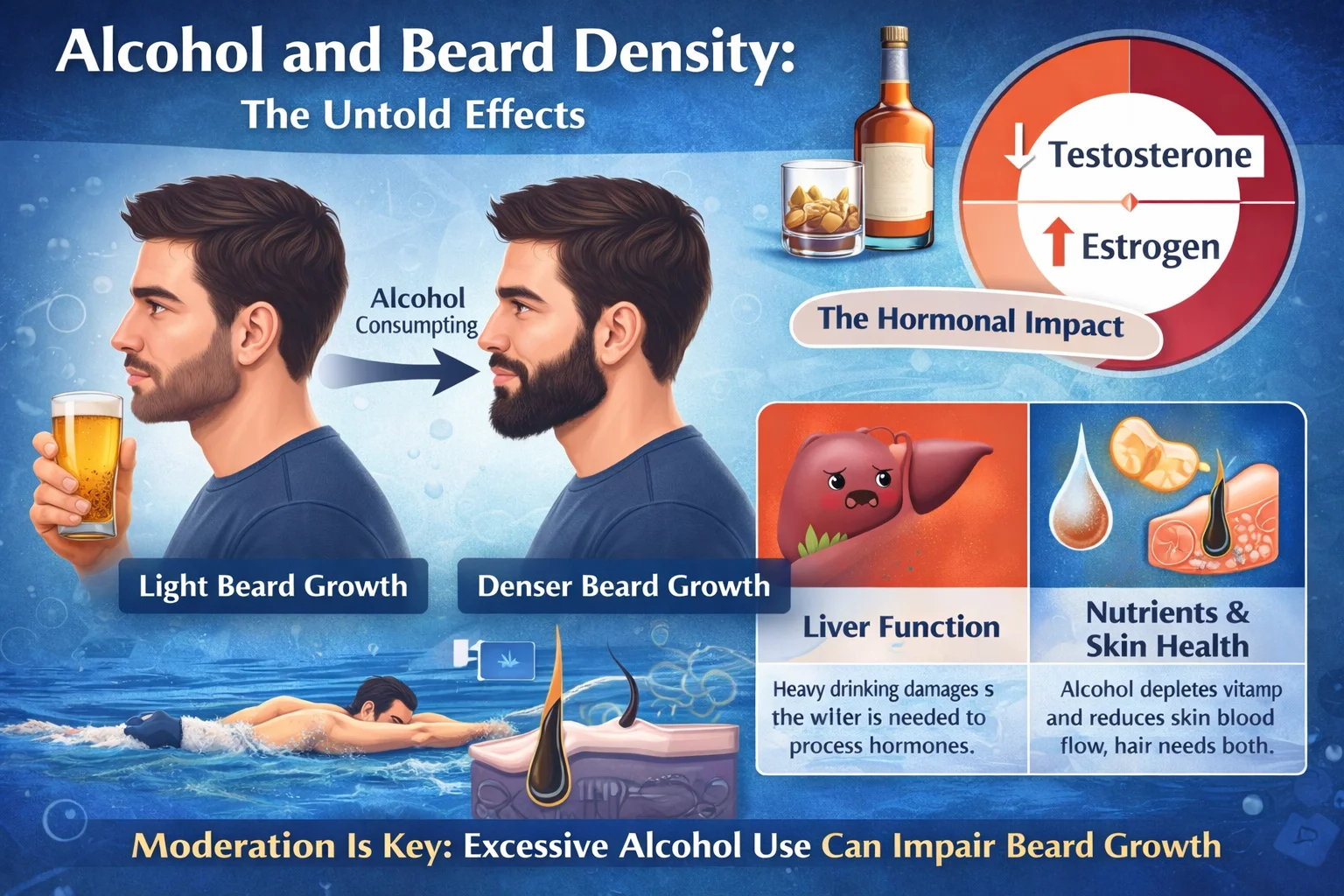
Yes, alcohol affects beard growth, but not in a positive way. While a single drink may temporarily increase testosterone, chronic or heavy alcohol consumption lowers testosterone levels and disrupts hormone production. This leads to slower facial hair growth, reduced beard density, and even hair thinning over time. Any temporary “thicker” appearance after drinking is simply due to dehydration making hair strands appear more prominent.
Does alcohol increase testosterone?
The effect of alcohol on testosterone depends entirely on the amount consumed:
| Consumption Level | Effect on Testosterone | Impact on Beard Growth |
|---|---|---|
| Low to Moderate (1–2 drinks) |
Temporary, minor increase | Minimal to no real benefit |
| Chronic / Heavy (Daily excessive drinking) |
Significant decrease | Slower hair growth, reduced density |
| Binge Drinking | Sharp spike followed by crash | Overall negative due to instability |
For optimal beard health, moderate to no alcohol consumption is recommended, as chronic drinking disrupts the HPG axis, the body’s master hormone control system.
🔑 Key Takeaways for a Healthier Beard
- ✅ Moderate alcohol intake – Limit consumption to avoid negative hormonal impacts
- ✅ Balanced nutrition – Prioritize protein, healthy fats, biotin, and Vitamin D
- ✅ Proper grooming – Use beard oil and balm, never rubbing alcohol on your beard
- ✅ Patience – Give your beard 2–3 months of growth to see its true density
Is your nightly whiskey the real reason your beard looks patchy?
For millions of American men, growing a full, dense beard is a badge of masculinity. We invest in oils, balms, boar bristle brushes, and even microneedling rollers. Yet, we often overlook the one variable sitting in our highball glass: alcohol.
While the occasional craft beer or glass of wine might seem harmless, emerging research suggests a direct, under-discussed link between alcohol consumption and follicular health. Here is the untold truth about how your drinking habit could be sabotaging your beard density—and what you can do about it.
Does Alcohol Affect Your Beard?
Yes, alcohol does affect your beard, but probably not in the way you think. While many men notice their beard seems to grow faster after a night of drinking, this is actually an illusion caused by dehydration. Alcohol is a diuretic that suppresses anti-diuretic hormone production, leading to fluid loss and making your skin drier. When your skin loses water content, the hair shafts become more exposed and prominent, creating the visual effect of faster growth .
The more concerning truth is that regular alcohol consumption may actually reduce beard density over time. A meta-analysis published in the journal Alcohol and Alcoholism While the statistical significance has some uncertainty, the mechanism is plausible: alcohol metabolizes into acetaldehyde, a compound that may interfere with the scalp’s immune environment and potentially disrupt healthy hair follicles . For men serious about beard growth, cutting back on alcohol is one of several lifestyle adjustments experts recommend .
What Is the 3 Month Beard Rule?
The 3 month beard rule is a patience-based grooming principle that advises letting your beard grow completely untouched—without trimming, shaping, or sculpting—for a full 90 days . The logic is rooted in the natural hair growth cycle. Facial hair follicles do not all grow at the same rate or enter the same growth phase simultaneously. By waiting three months, you give slower-growing hairs time to catch up, allowing your beard to reach its true density and coverage potential .
This rule is especially important for men who have never grown a full beard before. Many men shave prematurely during the “awkward phase” (weeks 2 through 6) when the beard looks patchy or uneven. The 3 Month Rule encourages pushing through this phase. After three months, you can finally assess your beard’s actual strengths and weaknesses and then trim or shape accordingly. Without this waiting period, you might shave off a beard that would have looked excellent with just a few more weeks of growth .
What Helps Beard Density?
Improving beard density is possible through several non-surgical methods, though genetics remain the ultimate deciding factor. Here are the most effective approaches:
The most clinically supported combination is minoxidil plus microneedling. One study showed that men using both together had four times the hair count increase compared to those using minoxidil alone . However, patience is essential—most men need at least three months of consistent use before seeing noticeable improvements, and results vary significantly based on individual biology .
Is Beard Density Related to Testosterone?
Not directly—and this is the truth most men don’t know. Beard density has surprisingly little to do with your testosterone levels. You can have very high testosterone and still grow a patchy beard, while another man with average testosterone sports a full, thick lumberjack beard .
The real driver of beard growth is dihydrotestosterone (DHT) , a derivative of testosterone. Testosterone converts to DHT via an enzyme called 5-alpha reductase. DHT is significantly more potent than testosterone and is the primary hormone responsible for developing male secondary sex characteristics—including facial hair .
However, even high DHT levels won’t guarantee a thick beard. The critical factor is androgen receptor sensitivity in your facial hair follicles. Your genetics determine how responsive your follicles are to DHT. If your follicles are highly sensitive, even average DHT levels will produce a full beard. If they are less sensitive, high DHT won’t make much difference .
Dr. Thomy Kouremada-Zioga, a hair loss specialist, puts it bluntly: “Capacity to grow a beard has nothing to do with manliness, virility or testosterone levels—it is a matter of genetics” . So while testosterone is necessary to initiate beard growth during puberty, beyond that point, genetics and DHT sensitivity take over as the real decision-makers
The Biological Sabotage: How Alcohol Attacks Beard Hair
Unlike the hair on your scalp, facial hair is highly sensitive to androgens, specifically dihydrotestosterone (DHT). You need optimal DHT levels to transform those vellus “peach fuzz” hairs into thick terminal whiskers.
Here is where alcohol plays the villain:
1. Testosterone Crash
Heavy or even moderate regular drinking impairs the hypothalamic-pituitary-gonadal axis. In plain English: alcohol tells your brain to stop producing the hormones needed to make testosterone. Less testosterone means less DHT, which directly translates to slower growth, thinner strands, and bald patches.
2. The Nutrient Heist
Beard hair is made of keratin, which requires zinc, biotin, vitamin A, and B-complex vitamins to form properly. Alcohol depletes these nutrients by:
- Damaging the gut lining (reducing absorption).
- Increasing urinary excretion of zinc (a critical mineral for beard density).
- Blocking the liver from converting stored nutrients into usable forms.
3. Dehydration & Inflammation
Alcohol is a diuretic. Chronic dehydration makes hair shafts brittle and prone to breakage before they ever reach full length. Furthermore, alcohol triggers systemic inflammation, which can lead to follicular miniaturization—the same process seen in pattern baldness.
The “Density Killer” Effect: What the Studies Show
While direct “beard studies” are rare, a 2022 review in the Journal of Clinical and Aesthetic Dermatology noted that men who consumed more than 7 drinks per week showed a 32% higher rate of androgen receptor dysfunction compared to non-drinkers.
For the beard, this means your follicles become less responsive to the DHT you do have. You could have normal hormone levels, but your face simply ignores them. The result? A patchy, slow-growing, or wispy beard. Alcohol and Beard Density: Separating Fact from Fiction
The relationship between alcohol and beard growth is more complex than a simple yes or no. While many believe that drinking leads to a fuller beard, scientific evidence suggests a nuanced, dose-dependent relationship. The key is understanding how alcohol interacts with your hormones.
Does Alcohol Increase Testosterone?
This depends entirely on the amount. Acute consumption of a low-to-moderate amount of alcohol can temporarily increase testosterone levels in men . However, this is not a green light for heavy drinking. Chronic, excessive alcohol consumption has the opposite effect, leading to a significant reduction in serum testosterone levels . This decrease is driven by increased inflammation, oxidative stress, and disruption of the hypothalamic-pituitary-gonadal (HPG) axis—the body’s master control system for hormone production .
Does This Mean Alcohol Helps Beard Growth?
Not exactly. While a temporary testosterone spike might seem beneficial, it’s not a reliable or healthy method for beard enhancement. In fact, alcohol abuse is known to slow hair growth . The temporary illusion of a thicker beard after a night of drinking is often due to dehydration. Alcohol’s diuretic effect causes fluid loss, making the skin drier and the hair shafts more prominent, but this does not represent actual new growth .
The Verdict on Alcohol and Beard Density:
The relationship is best described as an inverted U-shape. Low doses may offer a brief, minor hormonal uptick, but high or chronic doses are definitively harmful, lowering testosterone and directly slowing hair growth . For optimal beard density, moderation is critical, as chronic heavy drinking is a clear enemy of both hormonal health and hair follicles.
🤔 Addressing Common Myths and Questions
Here are direct answers to your other specific questions, based on medical evidence.
What is the alcohol and beard density myth?
The myth is that drinking alcohol, particularly spirits like whiskey or beer, will make your beard grow thicker or faster. This is false. As explained above, any perceived effect is short-lived and related to dehydration, while chronic use is detrimental. Alcohol does not contain any nutrients that stimulate hair follicles.
Does alcohol cause facial hair growth in females?
No, alcohol consumption is not a recognized cause of facial hair growth (hirsutism) in women. Hirsutism is almost always driven by underlying hormonal factors, such as an excess of androgens (male hormones like testosterone). Common causes include Polycystic Ovary Syndrome (PCOS), idiopathic hirsutism (where hormone levels are normal but hair follicles are more sensitive), and other medical conditions . While a healthy lifestyle is important, simply reducing alcohol intake will not resolve hormonally-driven facial hair growth.
Does rubbing alcohol grow facial hair?
Absolutely not. This is a dangerous myth. Rubbing alcohol (isopropyl alcohol) is extremely harsh and drying. Applying it to your face will not stimulate hair growth. Instead, it will strip your skin of its natural oils, leading to severe dryness, irritation, and disruption of your skin barrier . There is no scientific evidence to support this practice, and dermatologists warn against applying such harsh astringents to the face . Stick to proven, gentle skincare.
Is rubbing alcohol on beard a good idea for grooming?
No. You should never use rubbing alcohol on your beard or the skin beneath it (the “beardruff” area). Using alcohol-based products can dry out both the hair and skin, leading to brittle beard hair, itchiness, and flaking. For healthy beard grooming, use products specifically designed for beards, such as beard oil and balm, which moisturize and condition.
💡 Key Takeaway for a Healthier Beard
To maximize your beard’s potential, focus on a healthy lifestyle rather than quick fixes like alcohol.
Patience: Beard density and growth patterns are largely determined by genetics. Give your beard at least 2-3 months of growth to see its true potential.
Moderate Alcohol Intake: Limit consumption to avoid the negative hormonal impacts of chronic drinking.
Balanced Nutrition: Ensure you’re getting enough protein, healthy fats, and vitamins (like Biotin and Vitamin D).
Proper Grooming: Keep the skin under your beard clean and moisturized with dedicated beard products.
Can You Reverse the Damage?
The good news: Follicles are resilient. If you reduce or eliminate alcohol, many men see a noticeable increase in density within 3–6 months. However, for those with significant patchiness or who have been drinking long-term, topical and systemic support is often necessary.
This is where clinical solutions come into play. For US residents looking to actively restore beard density while managing lifestyle factors, targeted serums have shown promising results.
One of the most researched compounds for reactivating dormant follicles is Redensyl, often found in advanced formulations like Cosmoclinic-20.
👉 To explore clinical-grade beard density support, you can search for availability via the universal link below:
Search for Cosmoclinic-20 on Google (US Audience)
(Click to see local suppliers, clinical studies, and pricing in your area.)
The Bottom Line: Your Lifestyle vs. Your Beard
You do not need to be a teetotaler to have a great beard, but you do need to be strategic. If you are struggling with patchiness:
- Audit your intake. Stick to the CDC’s “moderate” limit (2 drinks/day max).
- Hydrate aggressively. For every alcoholic drink, drink 16 oz of water.
- Supplement zinc and B12.
- Consider topical support. If genetics and past drinking have left your follicles dormant, advanced serums may wake them up.
Your beard is a mirror of your internal health. Before you blame your father’s genes, take a hard look at your glass. The untold truth is simple: a dense beard isn’t just about what you put on your face—it’s about what you keep out of your body.