

Introduction
Learning how to grow facial hair—and how to grow better facial hair—is a journey that raises many questions. How long does it take? Can you speed it up? Do vitamins work? Is it all just genetics? Growing a Healthier Beard?
This guide combines evidence-based answers, practical routines, and realistic expectations to help you grow the best beard your genetics will allow.

Part 1: The Basics of Beard Growth
How Long Does It Take to Grow Facial Hair?
One of the most common questions is how long does it take facial hair to grow from scratch. On average, healthy facial hair grows about half an inch per month. Here’s a typical timeline:
| Stage | Timeframe | What to Expect |
|---|---|---|
| Stubble | 0–2 weeks | Noticeable stubble appears. |
| Light coverage | 2–4 weeks | Patchiness may still be visible. |
| Short beard | 1–2 months | The beard begins to take shape. |
| Fuller beard | 3–6 months | Most hairs have reached their potential length. |
So, how long to grow facial hair to a respectable length? Typically 2–3 months. But how long does it take to grow facial hair fully? For some men, 1 month is enough; for others, it takes 6+ months. Genetics play the biggest role.
How to Grow Facial Hair Faster (Naturally)

If you’re wondering how to grow facial hair faster or how to make facial hair grow faster, here are evidence-supported tips:
- Exercise regularly – Strength training, in particular, may help support healthy testosterone levels.
- Eat a protein-rich diet – Eggs, nuts, lean meats, and fish provide the building blocks for hair.
- Get enough sleep – Growth hormone is released during deep sleep.
- Manage stress – High cortisol levels can negatively impact testosterone.
Important reality check: You cannot dramatically speed up your natural growth rate. The average is roughly half an inch per month. No supplement or oil will change that fundamental biology.
How to Grow More Facial Hair & How to Grow Thicker Facial Hair
How to grow more facial hair and how to grow thicker facial hair are questions of maximizing your genetic potential, not changing it.
- Microneedling (derma rolling): Using a 0.5mm derma roller 2–3 times per week may help stimulate blood flow and collagen production to dormant follicles.
- Patience is key: Many men mistake “slow” growth for “no” growth. Give it time.
- Skin health: Clean, exfoliated skin prevents ingrown hairs and creates a healthy environment for follicles.

How to Grow Better Facial Hair
How to grow better facial hair means focusing on quality, not just quantity:
- Keep skin clean and exfoliated (prevents ingrown hairs).
- Moisturize daily—beard oil (more on this below) reduces itch and prevents breakage.
- Comb regularly to train hairs to grow downward.
- Resist the urge to trim too early.
How to Grow My Facial Hair: A Simple Routine
If you’re asking how to grow my facial hair properly:
- Week 1–4: Don’t shave. Resist trimming. Deal with the itch using beard oil.
- Week 4–8: Continue growing. Define your neckline (one finger-width above the Adam’s apple) if needed.
- Week 8+: Shape with good facial hair trimmers (see below).
Many men fail because they give up during the awkward early weeks. Patience is non-negotiable.

Good Facial Hair Trimmers
Once your beard grows in, you need a good facial hair trimmer to maintain shape. The best good facial hair trimmers offer:
- Adjustable length settings (0.5mm–20mm)
- Sharp, self-sharpening blades
- Cordless + waterproof designs
Top-rated brands include Philips Norelco, Braun, and Wahl.
A Note on Facial Hair Removal for Women
While this guide focuses on growth, facial hair removal for women is a related search topic. Options include dermaplaning, waxing, threading, and laser removal. That topic has its own best practices, but it’s included here because search engines often group facial hair questions together.
🌿 beard growth essentials · science-backed picks
shop the vitamins & supplements mentioned in our complete beard guide
💊 Biotin Vitamin B7
🦪 Zinc Mineral
☀️ Vitamin D3 Sunshine vitamin
🧬 Vitamin B12 Cobalamin
🐟 Collagen Peptides Hydrolyzed
🌴 Saw Palmetto herbal extract
💎 MSM Methylsulfonylmethane
🌻 Vitamin E (Evion 400) Tocopherol
🧢 Beard Growth Complex Biotin + Zinc + D3
🔍 search all beard growth supplements on Amazon
click below to browse Biotin, Zinc, Vitamin D, Collagen, Saw Palmetto, MSM & more — all products hand-picked from our article
🛍️ Amazon Storewide: beard & hair vitamins →📌 Store ID: cosmoclinic-20 · Universal search link: https://amzn.to/3POCQj3 (redirects to Amazon)
Part 2: The 3-Month Beard Rule (Most Important)
The “3-month beard rule” is a popular guideline that suggests letting your beard grow naturally for three full months without any significant trimming or shaping.
Why 3 Months?
- Different growth rates: Not all hairs on your face grow at the same speed. By waiting 3 months, you allow slower hairs time to catch up, revealing your beard’s true density and shape.
- Growth phases: The three months guide you through the frustrating early stages:
- Weeks 1-4: The itchy, often patchy stage.
- Weeks 5-8: The “awkward” phase where the beard looks uneven or scruffy.
- Weeks 9-12: The beard starts to look fuller and more like its final shape.
What the Rule Allows
Minimal grooming is fine: defining a neckline (usually one finger-width above the Adam’s apple) and using products like beard oil to moisturize the skin and soften the hair.
Realistic Expectation
The rule does not guarantee a full, thick beard for everyone. If your genetics determine you will have a patchy beard, three months won’t change that. But it will show you the absolute best version of your beard potential.
Part 3: Beard Growth Foods & Vitamins

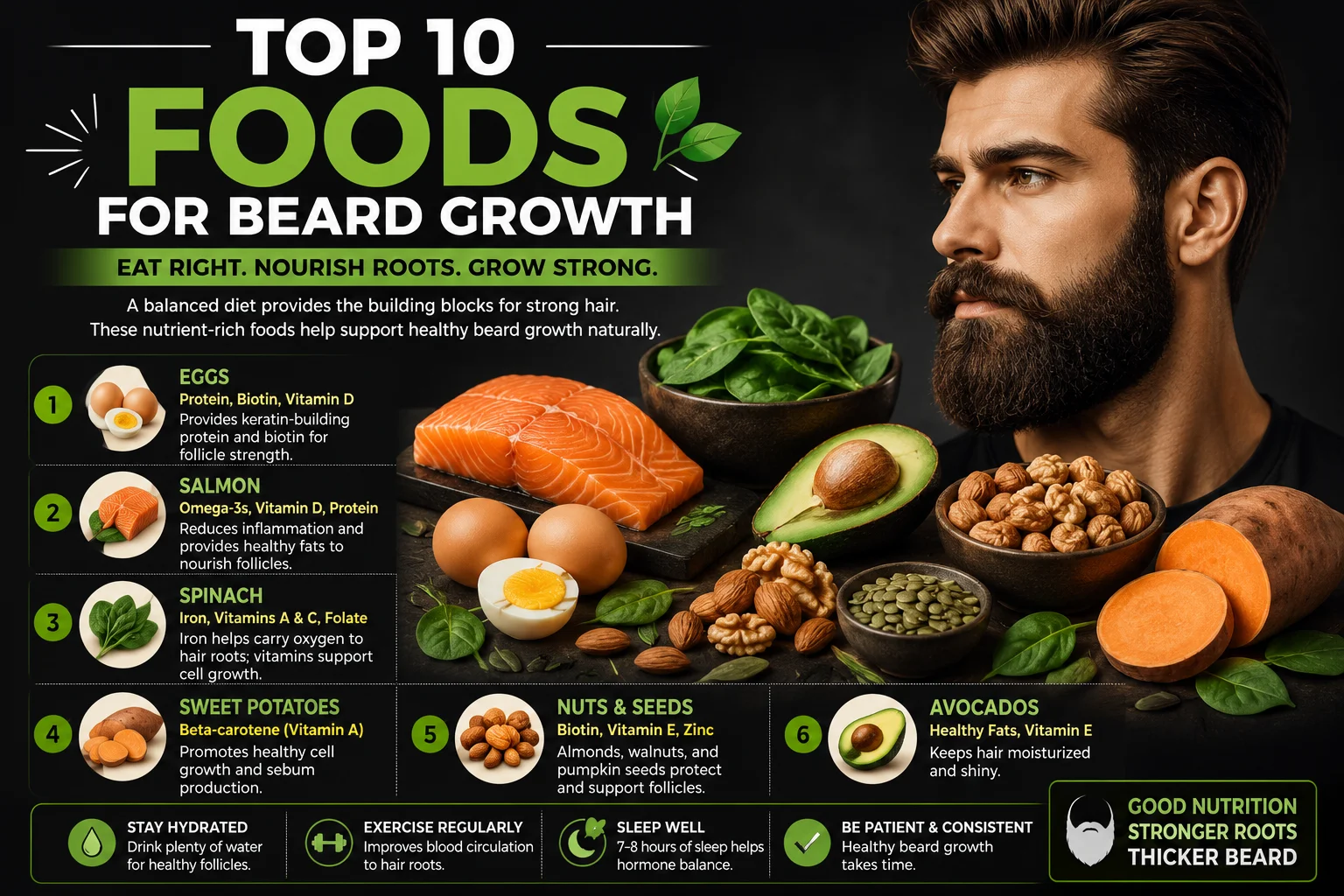
Top 10 Foods for Beard Growth
A balanced diet provides the building blocks for strong hair. While no single food guarantees a thicker beard, these are the most frequently recommended:
| Food | Key Nutrient | How It Helps Beard Growth |
|---|---|---|
| Eggs | Protein, Biotin, Vitamin D | Provides keratin-building protein and biotin for follicle strength. |
| Salmon | Omega-3s, Vitamin D, Protein | Reduces inflammation and provides healthy fats to nourish follicles. |
| Spinach | Iron, Vitamins A & C, Folate | Iron helps carry oxygen to hair roots; vitamins support cell growth. |
| Sweet Potatoes | Beta-carotene (Vitamin A) | Promotes healthy cell growth and sebum production. |
| Nuts & Seeds | Biotin, Vitamin E, Zinc | Almonds, walnuts, and pumpkin seeds protect and support follicles. |
| Avocados | Healthy Fats, Vitamin E | Keeps hair moisturized and shiny. |
| Greek Yogurt | Protein, Vitamin B5 | Supports hair structure and blood flow to follicles. |
| Garlic | Allicin | May improve blood circulation to follicles. |
| Citrus Fruits | Vitamin C | Aids in collagen production for healthy hair structure. |
| Oysters/Beef | Zinc | Supports tissue repair and oil gland function around follicles. |
Best Beard Growth Vitamins & Supplements: What the Evidence Says
Here is where reality matters most. While many supplements are marketed for beard growth, scientific evidence that they work for healthy men is very limited. Supplements generally only help if you have a diagnosed deficiency.
| Vitamin / Supplement | Claimed Benefit | What the Evidence Actually Says |
|---|---|---|
| Biotin (Vitamin B7) | Strengthens keratin in hair. | No strong evidence for beard growth unless you are deficient (rare). |
| Zinc | Supports protein synthesis and follicle function. | Only likely to help if you have a zinc deficiency. |
| Vitamin D | May help reactivate dormant follicles. | Deficiency is linked to hair loss, but evidence for supplementation is inconclusive. |
| Vitamin B12 | Supports overall hair health. | Will not cause beard growth if you are not deficient. |
| Collagen | Provides amino acids for hair structure. | No research specific to beard growth. |
| Saw Palmetto | Thought to block DHT (linked to hair loss). | Low-quality studies; evidence is not strong. |
| MSM | Promoted for hair, skin, and nails. | Very little evidence supports its use for beard growth. |
Important safety note: The FDA does not regulate supplements as strictly as prescription drugs. High doses of some (like zinc) can cause side effects, and biotin is known to interfere with important lab tests (including for heart attacks and thyroid function). Always consult a healthcare professional before starting a new supplement.
Can Evion 400 Grow a Beard?
Evion 400 is a specific brand of Vitamin E supplement. It is an antioxidant that is good for skin health. However, there is no strong evidence that taking Vitamin E will make your beard grow faster or thicker. Like other vitamins, it is essential for general health but is unlikely to change your genetic beard destiny.
Which Vitamin Is Best for Beard Growth? / Does B12 Grow a Beard?
No single vitamin is best. While Vitamin B12 is important for overall hair health, it is not uniquely responsible for beard growth and will not cause a beard to appear if you are not deficient. The same principle applies to most vitamins—they are essential for the process but are rarely the limiting factor.
Beard Growth Vitamin Supplements: Reviews & Amazon

Amazon customer reviews for beard growth supplements are highly mixed. One reviewer explicitly stated: “This will not make your beard grow faster, longer, or thicker… If you think this product makes your beard grow, you were experiencing the Hawthorne Effect (looking it up), or just the simple passage of time.” Other users on the same product reported feeling it made their beard feel “fuller and healthier.”
This wide range of opinions confirms that results are highly individual and may be influenced by expectation and general beard care, not just the supplement itself.
Part 4: The Genetics Question
Is Beard 100% Genetic?
Not 100%, but genetics is by far the biggest factor. Your genetics determine the potential of your beard—its pattern, density, and thickness.
The key is how sensitive your hair follicles are to the hormone testosterone and its derivative, DHT. This sensitivity is determined by your genes. Two men with the same testosterone levels can have drastically different beards because of this genetic sensitivity.
Scientists have identified over 500 DNA markers linked to facial hair thickness. A major one is the gene LNX1 on chromosome 4, which influences how thickly or sparsely your beard grows. Facial hair thickness is an “additive” trait, meaning the more “thick beard” gene variants you inherit from both parents, the more likely you are to have a thick beard.
Bottom line: If your father and grandfathers had full beards, you likely will too. If they didn’t, no supplement will change that.
Part 5: Beard Growth Oil – What It Actually Does
There is a lot of confusion about beard growth oil. Let’s be clear:
Beard oil is primarily a moisturizer for your facial hair and the skin underneath it. It can:
- Soften coarse beard hair
- Reduce itchiness (especially in the early growth stages)
- Prevent dryness and breakage
What beard oil does not do: There is no strong scientific evidence that beard oil makes hair grow faster or thicker. Its main benefit is improving the condition of the beard you already have.
Best facial hair oil products typically contain carrier oils like jojoba, argan, or castor oil, sometimes with essential oils like peppermint or rosemary (which have some preliminary evidence for stimulating follicles, though not specifically for beards).
Part 6: Putting It All Together – A Realistic Routine
If you want to optimize your beard’s potential, focus on consistency and patience. Here is a straightforward routine based on expert advice:
Weeks 1-4 (The Itch Phase)
- Do not shave. Resist the urge.
- Cleanse your face daily.
- Use beard oil to moisturize skin and reduce itch.
- Exfoliate 2-3 times per week to prevent ingrown hairs.
Weeks 5-8 (The Awkward Phase)
- Continue growing.
- Define your neckline (one finger-width above the Adam’s apple) if needed.
- Do not trim the cheeks or mustache yet.
- Consider using a 0.5mm derma roller 2-3 times per week on clean, dry skin to potentially stimulate blood flow.
Weeks 9-12 (The Reveal Phase)
- Your beard now shows its true density and shape.
- Use good facial hair trimmers to shape and maintain.
- Continue using beard oil daily.
- Evaluate your natural growth pattern honestly.
Beyond 3 Months
- If you’re happy with your beard, maintain with regular washing, oiling, and trimming.
- If your beard is patchier than you’d like, accept that this is your genetic potential. No supplement will create follicles where none exist.
Final Summary: What Actually Works
| Question | Answer |
|---|---|
| How long does it take to grow facial hair? | 2–6 months for most men to see full potential. |
| Can I grow a beard in 7 days? | No. That is biologically impossible. |
| Do vitamins help beard growth? | Only if you have a diagnosed deficiency. |
| Is beard 100% genetic? | Genetics is the single biggest factor. |
| Does beard oil make hair grow? | No. It moisturizes and conditions existing hair. |
| What is the 3-month rule? | Let your beard grow untouched for 90 days to see your true potential. |
| How to grow a beard faster? | You can’t dramatically speed it up, but good health helps. |
Final Advice
The market for beard growth products is filled with hype and pseudoscience. The truth is less exciting but more empowering:
- Your genetics set the ceiling. Accepting this saves time and money.
- Patience is non-negotiable. Follow the 3-month rule before judging your beard.
- Focus on health, not miracles. Eat well, sleep enough, exercise, and manage stress.
- Use beard oil for comfort and condition, not for growth.
- Invest in a good facial hair trimmer for maintenance once your beard grows in.
- Be skeptical of supplements. They are largely unregulated and unproven for this purpose.
If you choose to try supplements anyway, consult a healthcare provider first, look for independently tested products, and keep your expectations very low. The most likely outcome is that time and patience will do far more than any pill or oil ever could.
FAQS:
Takeaway: Maximize your health to reach your genetic ceiling. Accept that you cannot change that ceiling – and save money on unproven “miracle” products.
Quick Reference Summary
| Your Question | Short Answer |
|---|---|
| Full beard in 7 days? | ❌ Biologically impossible. |
| Do vitamins guarantee growth? | ❌ Only if you’re deficient. |
| Most important factor? | 🧬 Genetics (follicle sensitivity). |
| How long to see true potential? | ⏱️ 3 months (the 3‑month rule). |
| Does beard oil speed growth? | ❌ No – it moisturizes & reduces itch. |
🧔♂️ Beard growth: 3 essential FAQs
Evidence‑based answers · No hype · Backed by science
No — this is a common myth. Facial hair grows at an average rate of about half an inch per month (~1.25 cm). In just 7 days, you may achieve visible stubble, but never a full, dense beard.
✅ What you CAN do in 7 days: Start healthy habits (sleep, hydration, gentle exfoliation) and let your existing stubble grow without shaving to assess natural coverage.
⚠️ Any product promising a “full beard in one week” is misleading. True beard potential requires patience over 3 months — that’s the 3‑month rule.
No — supplements only help if you have a proven deficiency. For healthy men, studies show no strong evidence that biotin, zinc, vitamin D, or B12 increase beard thickness or speed growth when levels are already normal.
🔬 When they might help: If a blood test confirms deficiency (low zinc, low vitamin D, etc.), correcting it may improve overall hair health — but it won’t create new follicles where none exist genetically.
⚠️ Risks to know: High-dose biotin can interfere with lab tests (heart, thyroid). Unregulated supplements may contain ineffective or undisclosed ingredients.
Your genetics — specifically, your follicles’ sensitivity to androgens (testosterone & DHT). Over 500 DNA markers influence facial hair thickness, including the LNX1 gene on chromosome 4. This sensitivity is inherited from both parents.
📊 Two men with identical testosterone levels can have completely different beards because of this genetic sensitivity. That’s why your father’s and grandfathers’ beards are strong predictors.
✅ What you CAN control: Good nutrition, sleep, stress management, and skincare create the best environment for the hair you can grow. But no lifestyle change will turn a genetically thin beard into a dense one.
| Factor | Impact on beard growth |
|---|---|
| 🧬 Genetics (LNX1, androgen sensitivity) | ★ ★ ★ ★ ★ (dominant) |
| 🍏 Nutrition & deficiencies | ★ ★ ☆ ☆ ☆ (minor unless deficient) |
| 💤 Sleep & stress | ★ ★ ☆ ☆ ☆ (supports hormones) |
| 💊 Supplements (biotin, zinc, etc.) | ★ ☆ ☆ ☆ ☆ (only if deficient) |