
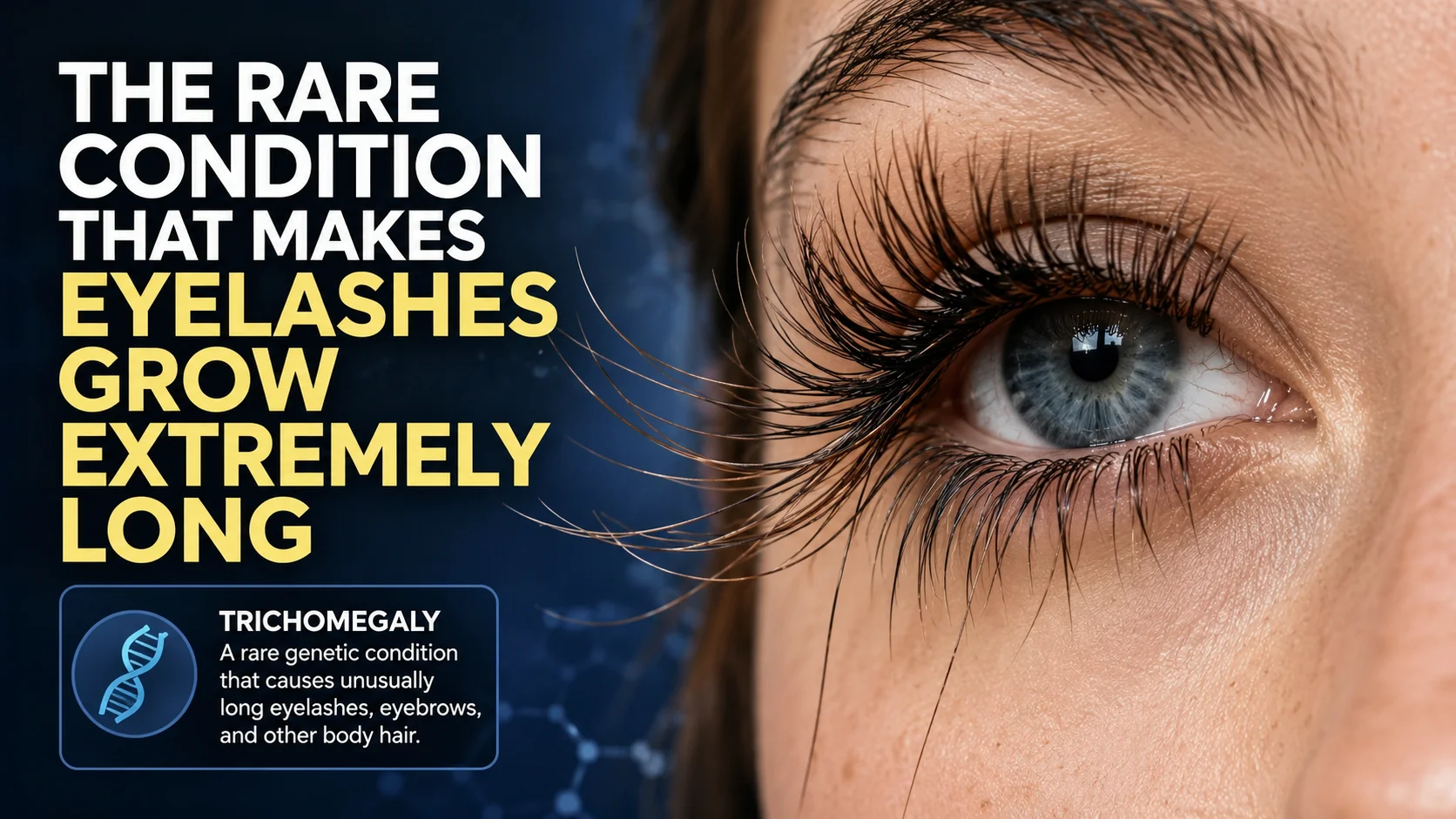

Trichomegaly is the medical term for the rare condition of having extremely long eyelashes. While often celebrated in popular culture as a sign of beauty, when eyelashes grow to an exceptional length—sometimes reaching up to 4 centimeters—it can be a sign of an underlying genetic syndrome, a side effect of medication, or a benign familial trait . The Rare Condition That Makes Eyelashes Grow Extremely Long, This phenomenon is formally defined as an increase in eyelash length to 12 mm or more, often accompanied by increased curling, thickness, or pigmentation .
Disclaimer: “Expert Clinician Recommends” represents the opinion of a licensed healthcare professional based on available clinical evidence, but individual results may vary. This information is for educational purposes only and does not constitute medical advice. Always consult your personal physician before starting any new supplement or wellness product. As an Amazon Associate, we earn from qualifying purchases.
† The product and claim are not evaluated by the FDA. This button links directly to the official Amazon product page. Prices and availability are subject to change.

Here is a quick overview of the primary reasons for this rare condition:
Congenital and Genetic Forms of Trichomegaly
🧬 Oliver-McFarlane Syndrome
The most well-documented syndromic form is Oliver-McFarlane syndrome (also known as trichomegaly-retina pigmentary degeneration-dwarfism syndrome). This is an extremely rare genetic disorder characterized by a distinct triad of symptoms .
- Trichomegaly: Abnormally long eyelashes (up to 4 cm) and eyebrows are present from birth .
- Progressive Retinal Degeneration: Patients experience progressive vision loss due to degeneration of the retina, often leading to night blindness and tunnel vision .
- Short Stature: Proportionate short stature and delayed physical development are key features .
- Additional Features: The syndrome can also involve intellectual disability, hypogonadism, and neurological disorders like ataxia .
🧬 Familial Isolated Trichomegaly
For some, trichomegaly occurs as an isolated trait without other health abnormalities. This is known as familial isolated trichomegaly, a rare genetic condition caused by mutations in the FGF5 gene . The FGF5 protein is a crucial regulator of the hair growth cycle, acting as a “stop signal” to end the active growth (anagen) phase. When this gene is mutated, the signal is lost, allowing eyelashes to continue growing much longer than usual . This form is inherited in an autosomal recessive pattern, meaning an individual must inherit a mutated copy of the gene from both parents .
🧬 Cornelia de Lange Syndrome
Trichomegaly is also a defining feature of Cornelia de Lange syndrome, a developmental disorder that affects many parts of the body. However, in this syndrome, the long eyelashes often occur alongside other distinct facial features and growth delays .
Acquired and Drug-Induced Trichomegaly
💊 Drug-Induced Trichomegaly
The most common cause of acquired trichomegaly is medication. Several drug classes are known to alter the hair growth cycle, often by prolonging the anagen phase .
- Prostaglandin Analogues: Topical drugs like latanoprost and bimatoprost, used primarily to treat glaucoma, are well-known for their side effect of lengthening, thickening, and darkening eyelashes . This effect was so pronounced that bimatoprost was later FDA-approved as a cosmetic treatment (Latisse®) for hypotrichosis (inadequate eyelashes) .
- EGFR Inhibitors: Cancer therapies such as cetuximab, erlotinib, and gefitinib (Epidermal Growth Factor Receptor inhibitors) can cause trichomegaly, usually 2-5 months after starting treatment . Interestingly, the presence of this side effect has been proposed as a potential clinical marker for a positive response to the anti-cancer therapy .
- Other Drugs: A wide range of other medications can induce this condition, including immunomodulators (cyclosporine, tacrolimus, interferon-alpha), anticonvulsants (phenytoin), and others like minoxidil and psoralens .
🏥 Trichomegaly as a Sign of Underlying Disease
The sudden appearance of long eyelashes in adulthood can sometimes signal an underlying medical condition .
- HIV Infection: Trichomegaly has been observed in patients with late-stage HIV infection. In some cases, eyelash length has been shown to normalize in response to effective antiretroviral therapy .
- Autoimmune and Inflammatory Diseases: Conditions like systemic lupus erythematosus (SLE), dermatomyositis, and atopic dermatitis have been associated with acquired trichomegaly .
- Other Conditions: It can also occur in cases of malnutrition (e.g., anorexia), hypothyroidism, and pregnancy . Very rarely, it presents as a paraneoplastic syndrome, a sign of an underlying malignancy such as metastatic adenocarcinoma .
Symptoms, Diagnosis, and Management
🔬 Symptoms and Associated Problems
While the primary symptom is the striking appearance of long, thick eyelashes, this can lead to secondary issues. The most common problem is ocular irritation, where the lashes brush against the eyeball, leading to discomfort, redness, and a sensation of a foreign body in the eye . In more severe cases, the lashes can cause trichiasis (misdirected growth) leading to corneal abrasions, which can potentially threaten vision . Some individuals may also experience increased sensitivity to light (photophobia) .
🩺 Diagnosis
Diagnosing the cause of trichomegaly involves a comprehensive approach :
- Medical History and Physical Exam: A detailed review of the patient’s medical history, including any recent illnesses and a complete list of medications, is crucial. A family history is also important to identify potential inherited forms .
- Ophthalmic Examination: A thorough eye exam, often using a slit lamp, allows the doctor to closely inspect the lashes and assess any damage to the cornea or conjunctiva .
- Further Testing: Depending on the suspected cause, tests may include blood work to check for HIV, autoimmune disorders, or thyroid dysfunction. In cases of suspected genetic syndromes, a referral to a geneticist for genetic testing may be recommended .
✂️ Treatment and Management
Treatment is dictated by the underlying cause and the severity of symptoms .
- Addressing the Cause: If trichomegaly is drug-induced, a doctor may consider switching the medication. If it’s linked to an underlying disease (like HIV or hypothyroidism), treating that condition may resolve the eyelash growth .
- Symptomatic Management: For asymptomatic individuals, no treatment is needed. If irritation occurs, the simplest and most common management is regular trimming of the eyelashes . Artificial tears can help with minor irritation .
- More Invasive Options: In persistent or severe cases where lashes cause corneal damage, options like epilation (plucking), electrolysis, or even surgical interventions may be considered to permanently remove the problematic lashes .
In summary, trichomegaly is a fascinating condition that sits at the intersection of genetics, pharmacology, and systemic disease. While it can be a benign and striking family trait, its sudden onset is a important sign that warrants a thorough medical evaluation to rule out underlying causes