
Disclosure: This post contains affiliate links. If you buy through them, we may earn a small commission at no extra cost to you. We only link to products we would reasonably recommend for the ingredients discussed. This is not medical advice — seborrheic dermatitis is a chronic medical condition, so please confirm your routine with a dermatologist or pharmacist.
If you have seborrheic dermatitis, you already know the routine: you find a shampoo that works, your scalp clears up for a few weeks, and then the flakes, itching, and that stubborn redness along your hairline creep back. So you switch products, and the cycle starts over.
Here’s the part most “best shampoo” lists skip: seborrheic dermatitis isn’t a hygiene problem. It’s a chronic, relapsing inflammatory condition driven by your skin’s reaction to Malassezia, a yeast that lives on almost everyone’s scalp. That single fact explains why the right answer isn’t one miracle bottle — it’s the right combination of active ingredients used on the right schedule.
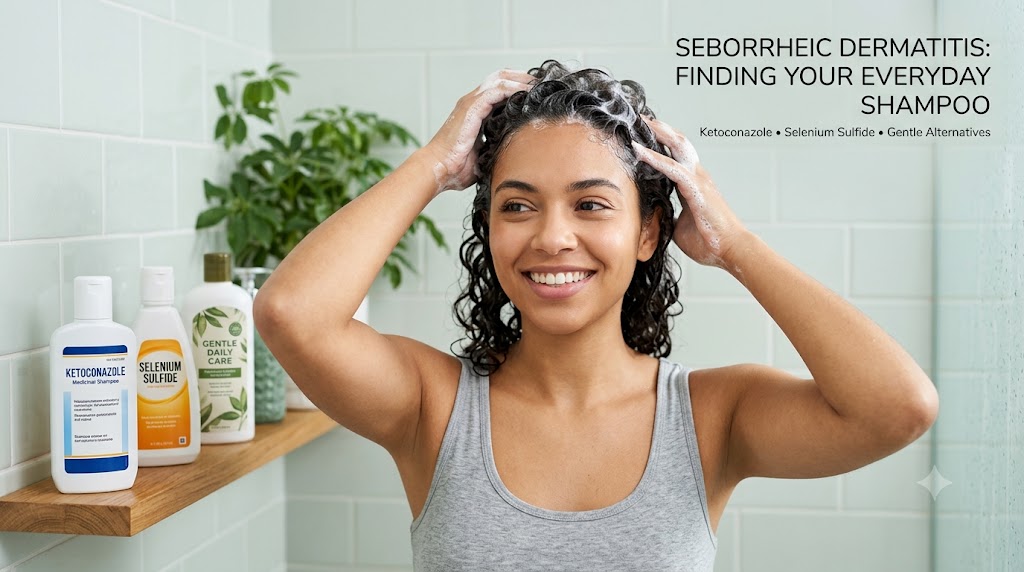
This guide breaks down the three families that actually matter — ketoconazole, selenium sulfide, and gentle everyday alternatives — including what each one does, how often it’s safe to use, who should avoid it, and how to rotate them so your scalp doesn’t build tolerance to your go-to formula. We’ll also cover the boring-but-critical stuff nobody mentions: surfactants, pH, fragrance, and why “gentle” doesn’t mean “ineffective.”
Find this guide useful? Make us a preferred source on Google.
★ Add as preferred source on GoogleTL;DR — The 30-Second Answer
- Best “everyday” pick: A fragrance-free, sulfate-free shampoo built on a mild surfactant system, used on non-treatment days. It cleanses without stripping the barrier that’s already inflamed.
- Best active for most people: Ketoconazole 1% (OTC) — the most studied antifungal for seborrheic dermatitis. Use 2–3× per week, leave on 3–5 minutes.
- Best for thick, oily scale: Selenium sulfide 1–2.5% — antifungal plus keratolytic. Watch out: it can tint blonde, gray, or color-treated hair.
- Best gentle daily active: Zinc pyrithione or piroctone olamine — mild enough for frequent use, useful for maintenance.
- The real secret: Rotate 2–3 actives on different days. Monotherapy is why your last bottle “stopped working.”
- Skip: Heavy fragrance, essential-oil bombs, and anything with drying alcohols if your scalp is already irritated.
What Seborrheic Dermatitis Actually Is (and Why It Changes Your Shampoo Choice)
Seborrheic dermatitis is a chronic inflammatory skin condition that shows up where your oil glands are densest: the scalp, the sides of the nose, eyebrows, behind the ears, and sometimes the chest. It causes greasy-to-dry flaking, itching, and redness that comes and goes in flares.
The current understanding points to three overlapping drivers:
- Malassezia yeast overgrowth. This lipophilic yeast is normal skin flora, but in susceptible people the immune system overreacts to it.
- A disrupted skin barrier. Barrier dysfunction lets irritants in and water out, which is why harsh surfactants make everything worse.
- Sebum composition and immune response. Genetics, stress, cold/dry weather, and hormonal shifts all modulate how badly you flare.
That’s why effective treatment almost always has two jobs: reduce the yeast and calm the inflammation without wrecking the barrier. A shampoo that does the first job but nukes the second will leave you flaky and irritated.
1. Ketoconazole: The Clinical Gold Standard
Ketoconazole is an imidazole antifungal that blocks ergosterol synthesis — the yeast equivalent of cholesterol — which disrupts Malassezia‘s cell membrane. It’s available OTC at 1% in the US and by prescription at 2%.
Why dermatologists reach for it first
- One of the most extensively studied topical antifungals for seborrheic dermatitis, with consistently strong results in clinical trials.
- Has some direct anti-inflammatory activity beyond its antifungal effect.
- Generally well tolerated, including for long-term intermittent use.
- Safe for color-treated hair — it doesn’t strip or shift dye.
How to use it properly
- Wet hair and scalp thoroughly.
- Apply and leave on for 3–5 minutes — this is the step almost everyone skips, and it’s the difference between a working treatment and an expensive rinse.
- Rinse well. Use 2–3 times per week during a flare, tapering to once weekly for maintenance.
- Follow with your regular conditioner on the ends only — not the scalp.
Limitations
Ketoconazole is not ideal as a daily shampoo. Overuse can dry the scalp, and because it’s a single-mechanism antifungal, some people notice diminishing returns after months of continuous use. It also does very little for thick, adherent scale — you may need a keratolytic partner.
Best for: Most people with confirmed seborrheic dermatitis, especially those who want a proven, color-safe active.
2. Selenium Sulfide: The Power Exfoliator
Selenium sulfide is a workhorse with a dual mechanism: it’s antifungal and it slows down epidermal cell turnover, which physically loosens the thick, yellowish scale that builds up on the scalp.
Where it shines
- Heavy, stubborn scale. If you can scrape visible plaques off your scalp, this is often the one that unblocks it.
- Oily scalp. It’s notably drying, which is a benefit here.
- Cost. Usually cheap and widely available at 1% (OTC) and 2.5% (Rx).
The catch: hair and color
Selenium sulfide can discolor blonde, gray, silver, and color-treated hair, and it can leave a metallic or sulfurous smell. It’s also more irritating to sensitive or eczema-prone skin. If any of those apply to you, keep it on the scalp and off the lengths, and cap it at 2× per week.
How to use it properly
- Shake the bottle — it separates.
- Massage into the scalp only, leave on 2–5 minutes, then rinse thoroughly.
- Use twice weekly max during flares.
- Use a deep conditioner on the ends afterward to offset the dryness.
Best for: Thick, oily, adherent scale; people with darker or non-color-treated hair; short-term flare control.
3. Gentle Alternatives You Can Actually Use Every Day
Here’s the piece most guides get wrong. “Everyday shampoo” doesn’t mean “medicated shampoo used daily.” It means a shampoo formulated so it doesn’t undo your treatment days. Between ketoconazole sessions, your scalp needs barrier support — not another round of stripping surfactants.
Gentle actives worth knowing
Zinc Pyrithione (1%)
An antifungal with a long safety record that’s mild enough for frequent use. Widely available in drugstore shampoos. Note: regulatory status varies by region — it was restricted in the EU, so availability depends on where you live. Still common in the US.
Piroctone Olamine
Very popular in Europe and increasingly in the US. Effective against Malassezia, notably gentle, and often paired with mild surfactants. An excellent daily-use active if you can find it.
Ciclopirox Olamine 1%
Prescription antifungal with a broader spectrum than ketoconazole. Usually reserved for cases that haven’t responded to first-line options.
Salicylic Acid
Not an antifungal — it’s a keratolytic that softens scale so your antifungal can reach the skin. Useful as a pre-treatment, not a standalone fix.
Coal Tar
Anti-inflammatory and effective for scale, but strong-smelling, potentially staining, and generally a second-line option. Some people find it very helpful for stubborn cases.
What to look for in the base formula
| Look for | Avoid (if your scalp is inflamed) |
|---|---|
| Mild surfactants: coco-glucoside, lauryl glucoside, sodium cocoyl isethionate, cocamidopropyl betaine | Harsh sulfates: sodium lauryl sulfate (SLS) in high concentrations |
| Fragrance-free or low-fragrance formulations | “Refreshing,” “tingling,” or menthol-heavy formulas |
| Barrier support: glycerin, niacinamide, panthenol, colloidal oatmeal, ceramides | High concentrations of essential oils (tea tree, peppermint, eucalyptus) — common irritants |
| pH close to scalp pH (mildly acidic, ~4.5–5.5) | Drying alcohols high in the ingredient list (denatured alcohol, SD alcohol) |
The takeaway: a gentle everyday shampoo isn’t the treatment — it’s the thing that keeps your treatment working. Treat it as the foundation, not the fix.
Side-by-Side Comparison
| Ingredient | How it works | Typical use | Best for | Watch out for |
|---|---|---|---|---|
| Ketoconazole 1–2% | Antifungal (blocks ergosterol); mild anti-inflammatory | 2–3×/week, leave 3–5 min | Most people; color-treated hair | Drying with overuse; single mechanism |
| Selenium sulfide 1–2.5% | Antifungal + slows cell turnover (keratolytic) | 1–2×/week, leave 2–5 min | Thick, oily, adherent scale | Discolors blonde/gray/dyed hair; odor; irritation |
| Zinc pyrithione 1% | Antifungal | Can be used more frequently | Maintenance; mild cases | Regional regulatory limits |
| Piroctone olamine | Antifungal | Daily to several times weekly | Gentle daily control | Less widely available in some markets |
| Ciclopirox 1% | Broad-spectrum antifungal | 2×/week (Rx) | Non-responders | Prescription required |
| Salicylic acid | Keratolytic — lifts scale | As a pre-treatment | Loosening buildup | Not antifungal alone; drying |
| Gentle base shampoo | Cleanses without stripping | Daily / on off-days | Barrier support between treatments | No antifungal action on its own |
The Rotation Schedule That Actually Works
If you take one practical thing from this article, take this: rotate your actives. Continuous use of a single antifungal is the most common reason people report that a product “stopped working.”
A simple, dermatologist-aligned weekly structure:
| Day | What to use |
|---|---|
| Monday | Ketoconazole 1% — leave 3–5 min |
| Tuesday | Gentle everyday shampoo |
| Wednesday | Gentle everyday shampoo |
| Thursday | Selenium sulfide 1% — leave 2–5 min |
| Friday | Gentle everyday shampoo |
| Saturday | Ketoconazole 1% or zinc pyrithione |
| Sunday | Gentle everyday shampoo |
Once your scalp is calm: drop to one medicated wash per week for maintenance, and keep the gentle shampoo as your default. Flares will still happen — seasonal changes, stress, and travel are common triggers — so keep a treatment bottle on hand rather than waiting for a refill.
Q: What is the best everyday shampoo for seborrheic dermatitis?
A: The best everyday shampoo for seborrheic dermatitis is a fragrance-free, sulfate-free shampoo with a mild surfactant base, used on the days you’re not using a medicated treatment. For the active treatment itself, ketoconazole 1% is the most well-supported option for most people, used 2–3 times per week and left on the scalp for 3–5 minutes before rinsing. If you have thick, oily scale, selenium sulfide 1–2.5% is more effective at loosening buildup. Most dermatologists recommend rotating two or three different actives across the week rather than relying on a single shampoo daily.
Want to see the exact gentle formula we recommend for off-days? It’s fragrance-free, built on mild surfactants, and designed not to undo your treatment days.
🏷️ Check Current Discount on Our Top PickAffiliate link · price and availability can change
Not ready to commit? Read what people with seborrheic dermatitis actually say after 30 days before you decide.
🔍 View Customer ReviewsAffiliate link · opens in a new tab
FAQs
Can I use ketoconazole shampoo every day?
You can, but you generally shouldn’t. Ketoconazole is typically used 2–3 times per week because daily use can dry and irritate the scalp without adding antifungal benefit. On the other days, use a gentle, fragrance-free shampoo to support your skin barrier. If your dermatologist has given you a different schedule, follow that instead.
Which is better for seborrheic dermatitis — ketoconazole or selenium sulfide?
They do different jobs, which is why many people use both. Ketoconazole is a targeted antifungal with strong clinical evidence and is safe for color-treated hair. Selenium sulfide is antifungal and keratolytic, so it’s better at removing thick, adherent scale, but it can discolor blonde, gray, or dyed hair and is more drying. A common approach is ketoconazole for routine control and selenium sulfide once or twice weekly when scale builds up.
Why did my seborrheic dermatitis shampoo stop working?
Usually one of three reasons: (1) you’re using a single active continuously and the yeast population has adapted, (2) you’re not leaving the product on long enough for it to work (3–5 minutes matters), or (3) your barrier is compromised from over-washing, which mimics a flare. Rotating two or three actives and reducing wash frequency often resolves it.
Is zinc pyrithione safe for daily use?
In markets where it’s permitted, zinc pyrithione is considered mild enough for frequent use and is a reasonable maintenance active. Regulatory status differs by region — it has been restricted in the EU — so check local availability and labeling. If you have sensitive skin, patch test first.
Does tea tree oil help seborrheic dermatitis?
Some small studies suggest tea tree oil has antifungal activity against Malassezia and may reduce symptoms. However, it’s also a common cause of allergic contact dermatitis, especially at higher concentrations or in leave-on products. If you want to try it, use a low-concentration wash-off product and stop immediately if you notice burning or increased redness.
How long until a seborrheic dermatitis shampoo starts working?
Most people notice reduced flaking and itching within 1–2 weeks of consistent use, with more noticeable clearing by 4 weeks. If there’s no improvement at all after four weeks of correct use — including proper contact time — see a dermatologist, since the diagnosis may be different or you may need a prescription-strength option.
Can seborrheic dermatitis be cured permanently?
No. Seborrheic dermatitis is a chronic, relapsing condition. It can be managed very effectively and kept in remission for long stretches, but it isn’t permanently cured. Maintenance therapy — typically one medicated wash per week plus a gentle daily shampoo — is what keeps flares from returning.
Is a sulfate-free shampoo better for seborrheic dermatitis?
Often, yes. Sulfates like SLS are effective cleansers but can strip the skin barrier and worsen irritation, particularly during an active flare. Sulfate-free formulas using glucosides or isethionates clean adequately while being much gentler. That said, the antifungal active matters more than the surfactant — a gentle shampoo with no active won’t treat the condition.
Should I use conditioner with seborrheic dermatitis?
Yes, but apply it to the mid-lengths and ends only, keeping it off the scalp. Many conditioners contain oils and silicones that can feed Malassezia and contribute to buildup. If your scalp is oily, consider skipping conditioner near the roots entirely.
When should I see a dermatologist instead of self-treating?
See a dermatologist if: OTC shampoos haven’t helped after 4 weeks of correct use, your scalp is severely inflamed, weeping, or bleeding, you have hair loss, the rash has spread to your face or body, or you have a weakened immune system. Prescription options like 2% ketoconazole or ciclopirox may be needed.
Medical Disclaimer: This article is for general informational purposes only and is not a substitute for professional medical advice, diagnosis, or treatment. Seborrheic dermatitis is a medical condition, and individual responses to treatments vary. Always consult a qualified dermatologist, physician, or pharmacist before starting, stopping, or changing any treatment — especially if you are pregnant, breastfeeding, immunocompromised, or using other topical medications. Never disregard professional medical advice because of something you read online. If you experience a severe reaction, stop use and seek medical attention.
Affiliate Disclosure: Some links in this article are affiliate links, meaning we may earn a commission if you make a purchase — at no additional cost to you. This does not influence which ingredients or products we discuss. We do not accept payment to write positive reviews of specific products, and we recommend consulting your clinician regardless of any product mentioned here.
P.S. — If you only do one thing after reading this, make it this: set a 3-minute timer the next time you use a medicated shampoo. Contact time is the single most-skipped step in seborrheic dermatitis care, and it’s free. Do that consistently for two weeks, and you’ll know far more about what actually works for your scalp than any review section can tell you.
And if you’d rather start with the gentle, everyday base that makes the whole rotation work, that’s the one we linked above — it’s the piece most people forget to buy.