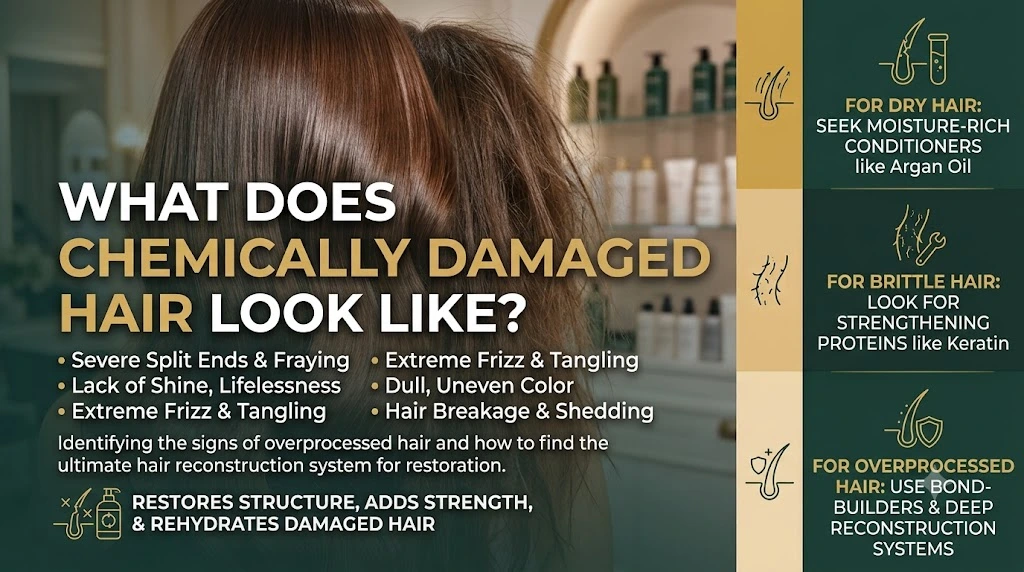

Chemically damaged hair often looks dry, dull, frizzy, and brittle with visible split ends, uneven porosity, and a “straw-like” texture. It may stretch and snap easily, lack shine, and feel rough to the touch. But here’s the good news: with the right repair treatments — like the ones from Jumy Bee — you can restore smoothness, strength, and shine. Scroll down to see each sign in detail + how to fix it.
📑 Table of Contents
What does chemically damaged hair look like? If you’ve been bleaching, perming, relaxing, or even over-using heat tools, you might be staring at the answer in the mirror — but not knowing exactly what to look for. Chemical damage doesn’t always scream for help; sometimes it whispers in subtle ways.
In this guide, we break down 12 telltale signs of chemically damaged hair, from the obvious (split ends) to the sneaky (loss of elasticity). Plus, we’ll show you how to repair and restore your strands with the right treatments.
🔥 Your Hair Is Crying for Help — Listen to It!
1. Dry, Straw-Like Texture 🧵
🔴 What it looks like:
Your hair feels rough, coarse, and resembles dry hay or straw. It no longer has that soft, silky slip when you run your fingers through it.
This is the #1 complaint from women with chemical damage. Bleach, relaxers, and perms strip the natural lipid layer, leaving the cuticle raised and rough.
2. Excessive Breakage & Shedding ⚡
🟠 What it looks like:
You find short, broken hairs on your pillow, in your brush, or on your shower floor. The hair snaps off easily, especially when wet.
Chemical treatments weaken the protein bonds (keratin) in your hair. When those bonds break, the hair loses its structural integrity and snaps under minimal tension.
3. Split Ends That Travel Up ✂️
🟡 What it looks like:
Not just a few split ends — but splits that run halfway up the hair shaft, creating a “feathered” or “tree branch” appearance.
When the protective cuticle is compromised, the inner cortex unravels. This splitting travels upward if not trimmed, making your hair look thin and ragged at the ends.
4. Dull, Lifeless Appearance 🌀
🟢 What it looks like:
Your hair lacks shine and looks flat, even after washing. It doesn’t reflect light the way healthy hair does.
Healthy hair has a smooth cuticle that reflects light, creating natural shine. Chemical damage roughens the cuticle, scattering light and making hair appear dull and lackluster.
5. Frizz That Won’t Tame 🌀
🟣 What it looks like:
Frizz is constant — even in low humidity. Your hair puffs up, and no serum or oil seems to calm it down permanently.
When the cuticle is raised (from chemical processing), moisture from the air enters and swells the hair, causing uncontrollable frizz. This is a classic sign of porosity imbalance.
6. Uneven Porosity 💧
🟤 What it looks like:
Some sections of your hair soak up water instantly, while others repel it. Your hair dries at different speeds and feels “gummy” in some areas.
Chemicals create inconsistent porosity along the hair shaft. Overly porous areas absorb too much moisture (and break), while less damaged areas remain resistant.
7. Elasticity Loss (Snaps Easily) 💥
🔴 What it looks like:
When you gently pull a strand, it doesn’t stretch — it simply snaps. Healthy hair should stretch about 30% before breaking.
Chemical damage breaks the disulfide bonds that give hair its elasticity. Without these bonds, hair becomes brittle and rigid, leading to sudden breakage.
8. Color Fades Fast 🎨
🟠 What it looks like:
Your salon color washes out within 2–3 weeks, leaving you with faded, brassy tones, even with color-safe shampoos.
Damaged cuticles can’t “hold” color molecules. They leach out quickly, making your hair look washed out and uneven.
9. Tangled & Matted Ends 🌀
🟡 What it looks like:
Your ends tangle into tiny knots (fairy knots) and mat together, making detangling a painful, time-consuming ordeal.
Raised cuticles interlock with each other, creating friction and tangles. This leads to mechanical damage during brushing, making the problem worse.
10. Rough Cuticle (Looks “Fuzzy”) 🔬
🟢 What it looks like:
Under a microscope (or even with a magnifying mirror), the hair shaft looks scaly, rough, and uneven — like a pinecone.
The outer protective layer is eroded or lifted, exposing the cortex. This is the physical manifestation of chemical damage.
11. No Bounce or Body 🏋️
🟣 What it looks like:
Your hair lies flat and limp, even after blow-drying with volume products. It lacks movement and falls straight down without any natural curve.
Chemical damage destroys the hair’s internal structure, reducing its ability to hold shape or bounce. The cortex loses its coiled strength.
12. Smell of Chemicals Lingers 🧪
🟤 What it looks like:
Even after multiple washes, you can still smell the ammonia, bleach, or perm solution in your hair.
Chemicals can become trapped in the damaged cortex. This is a strong indicator that your hair’s structure is compromised and needs professional-level repair.
✨ Stop Wondering — Start Restoring!
How to Repair Chemically Damaged Hair
Now that you know what does chemically damaged hair look like, here’s how to fix it:
- ✅ Deep conditioning treatments — Look for protein-rich masks that rebuild keratin bonds.
- ✅ Trim regularly — Remove split ends to prevent them from traveling up.
- ✅ Reduce heat styling — Give your hair a break from flat irons and blow dryers.
- ✅ Use bonding repair systems — Products like Jumy Bee’s 3-Step Keratin Treatment rebuild disulfide bonds.
- ✅ Be patient — Repair takes time. But with consistency, you’ll see noticeable improvement in 4–6 weeks.
🌟 Your Hair Is Not a Lost Cause.
Every single one of the signs above can be reversed with the right care. You are not broken — your hair just needs a little love.
This article contains affiliate links. If you make a purchase through these links, we may earn a small commission at no extra cost to you. We only recommend products we’ve researched and believe can genuinely help repair chemically damaged hair. Individual results may vary based on hair type, damage severity, and consistency of use.
⚠️ Important: Always perform a patch test before using any new hair treatment. Consult a professional stylist if you’re unsure about your hair’s condition.
💪 Ready to Fall in Love with Your Hair Again?
Join thousands of women who’ve reversed chemical damage with Jumy Bee. Your hair deserves a second chance.
Shop Jumy Bee Treatments →