

📑 Table of Contents
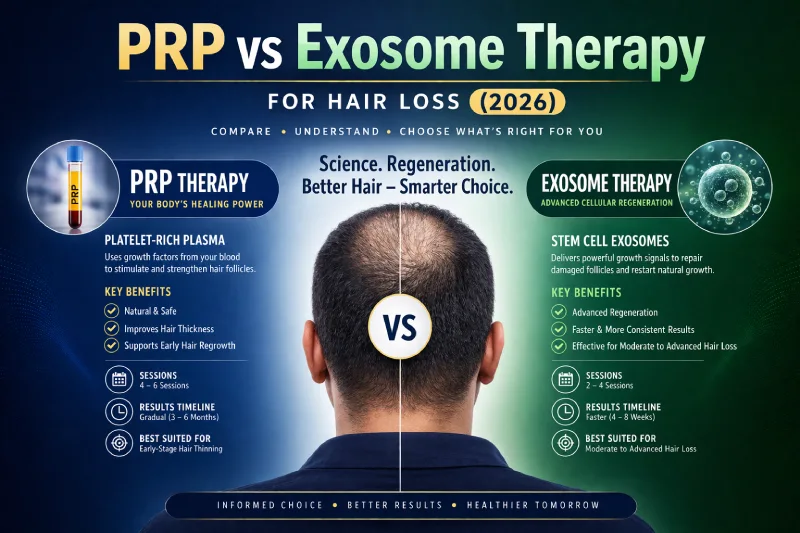
When it comes to cutting-edge hair loss treatments, two names dominate the conversation: Exosome Hair Therapy and Platelet-Rich Plasma (PRP). Both are celebrated for their regenerative potential, but they work in fundamentally different ways. If you are trying to decide between them, understanding the science, benefits, and clinical evidence is crucial.
What is PRP Hair Therapy?
Platelet-Rich Plasma (PRP) therapy is a natural, autologous treatment that uses your own blood to stimulate hair growth. The process involves drawing a small amount of blood, which is then placed in a centrifuge to separate the platelet-rich plasma from other blood components. This concentrated plasma, rich in growth factors, is then injected into the scalp.
The Science: PRP works by delivering a high concentration of growth factors (like VEGF, EGF, and PDGF) directly to the hair follicles. These proteins kick-start dormant follicles, extend the anagen (growth) phase, and improve blood circulation to the scalp. It is often described as a “natural” approach because it utilizes the body’s own healing mechanisms.
Benefits of PRP:
- Uses the patient’s own biological material (autologous), minimizing the risk of allergic reactions.
- Well-established treatment with a mature evidence base, including over 43 randomized controlled trials.
- Effective for early to moderate stages of hair thinning.
- A good option for those who prefer a treatment derived from their own body.
What is Exosome Hair Therapy?
Exosome therapy represents the next generation of regenerative medicine. Instead of using whole blood, this treatment uses exosomes—tiny extracellular vesicles that act as “messengers” between cells. These exosomes are derived from stem cells (often mesenchymal stem cells) and are packed with proteins, lipids, growth factors, and genetic material.
The Science: Exosomes are significantly smaller than platelets, allowing them to penetrate deeper into the scalp. They work at a cellular level to promote tissue repair, reduce inflammation, and communicate directly with hair follicle stem cells to trigger regeneration. A key advantage is that exosomes can be precisely formulated for a high concentration and standardised potency, unlike PRP, which varies from patient to patient.
Benefits of Exosome Therapy:
- Higher Potency: Contains a much higher concentration of growth factors and signaling molecules compared to PRP.
- Standardized Quality: Unlike PRP, exosome products are often manufactured under controlled conditions, ensuring consistent quality.
- Better Tolerability: Research suggests exosome therapy causes less transient local reactions (e.g., swelling, soreness) compared to PRP.
- Targets advanced hair thinning and scarring alopecia more effectively.
Head-to-Head: Exosome Therapy vs. PRP
1. Efficacy (The Science)
A randomized controlled clinical trial published in 2026 provided a direct comparison. The results were striking:
- Hair Density Increase: Exosome therapy increased hair density by 44.4 hairs/cm², while PRP only achieved 26.3 hairs/cm².
- Terminal/Vellus Hair Ratio: Exosomes significantly improved the ratio of thick, healthy hairs to thin, miniaturized hairs (from 2.4 to 9.7) compared to PRP (4.8).
- Anagen Proportion: Exosomes increased the percentage of hairs in the active growth phase by 36.4%, compared to 23.4% for PRP.
The study concluded that exosomes demonstrated significant advantages over PRP across the majority of evaluated parameters, even requiring fewer sessions.
2. Treatment Protocols
- PRP: Typically requires an initial course of 3-4 sessions, spaced 4 weeks apart. Maintenance treatments are usually needed once or twice a year.
- Exosome Therapy: Often recommended as a course of 3-6 treatments, spaced 2-4 weeks apart. Results can be seen faster than PRP due to the higher concentration of active ingredients.
3. Source and Safety
- PRP: Autologous (from you). Low risk of rejection, but the quality depends on your health and platelet count.
- Exosomes: Generally derived from allogeneic sources (donor stem cells, or recently even salmon tissue). They are considered safe due to their low immunogenicity.
4. Evidence Base
- PRP: Has the strongest and most mature evidence base, particularly as an adjunct to hair transplants. Its long-term effects and protocols are well-documented.
- Exosome Therapy: Has less mature clinical evidence, but the data that exists is highly promising and shows superior potency. It is often considered “investigational” in specific contexts like hair transplantation.
Which Treatment is Right for You?
Choose PRP if:
- You are in the early stages of hair thinning.
- You prefer a treatment using your own biological material.
- You want a well-documented, proven treatment with decades of research behind it.
Choose Exosome Therapy if:
- You have moderate to advanced hair loss and have not responded well to other treatments.
- You want a more potent, concentrated, and standardised treatment.
- You are looking for faster and more dramatic results, based on new clinical data.
- You want a treatment with potentially better tolerability and fewer side effects.
“The better option is the one that matches the diagnosis… Consultation prevents unnecessary treatment and supports a more elegant, evidence-conscious approach.”
FAQs
Yes, recent clinical trials indicate that exosome therapy offers superior results in hair density, thickness, and the ratio of healthy to miniaturized hairs compared to PRP. However, PRP has a longer, more established track record.
Yes, they can be complementary. Some clinics use PRP as a foundational treatment and exosomes as an advanced adjunct. Research even suggests that PRP-derived exosomes (PRP-Exos) may be the key active ingredient in PRP’s success, combining the benefits of both.
Both are considered safe. PRP uses your own blood, eliminating the risk of disease transmission, but the quality varies. Exosomes have low immunogenicity, and a recent study found that transient local reactions were significantly less common with exosomes (40%) than with PRP (70%).
Most practitioners recommend a course of three to six sessions, spaced 2-4 weeks apart. Optimal hair growth is usually visible 6-12 months after the final session.
For male pattern baldness (androgenetic alopecia), the data currently favors exosomes. The 2026 study showed that salmon tissue-derived exosomes significantly outperformed PRP in men with Norwood-Hamilton stages III–IV.

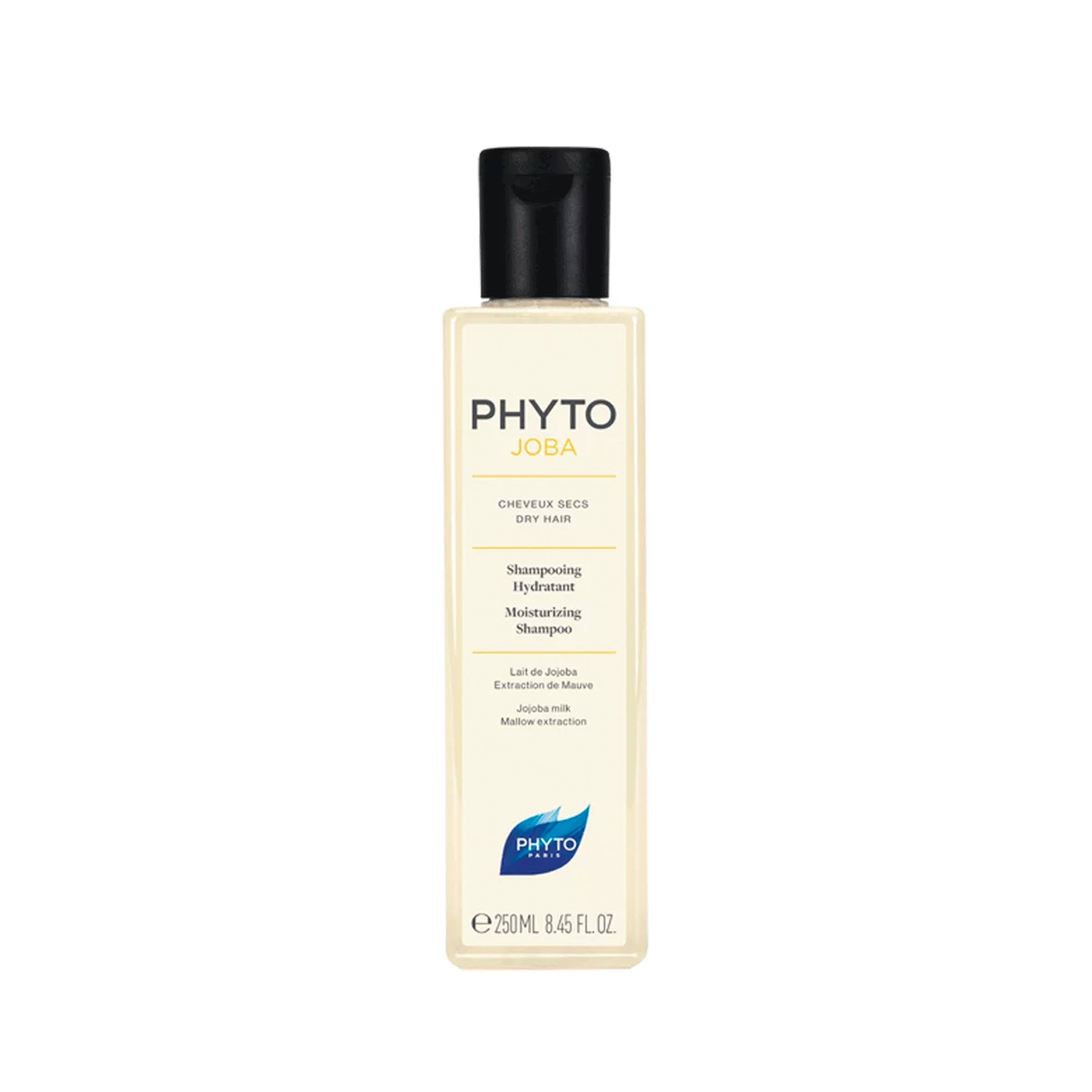
Some links in this article are affiliate links, meaning we may earn a small commission if you purchase a product through these links, at no additional cost to you. We only recommend products we believe could be beneficial for hair health, such as the Phytocyane Densifying Treatment for Men and the Phytojoba Moisturizing Shampoo.
© 2026 · Evidence-based hair restoration guide. Always consult your physician.