
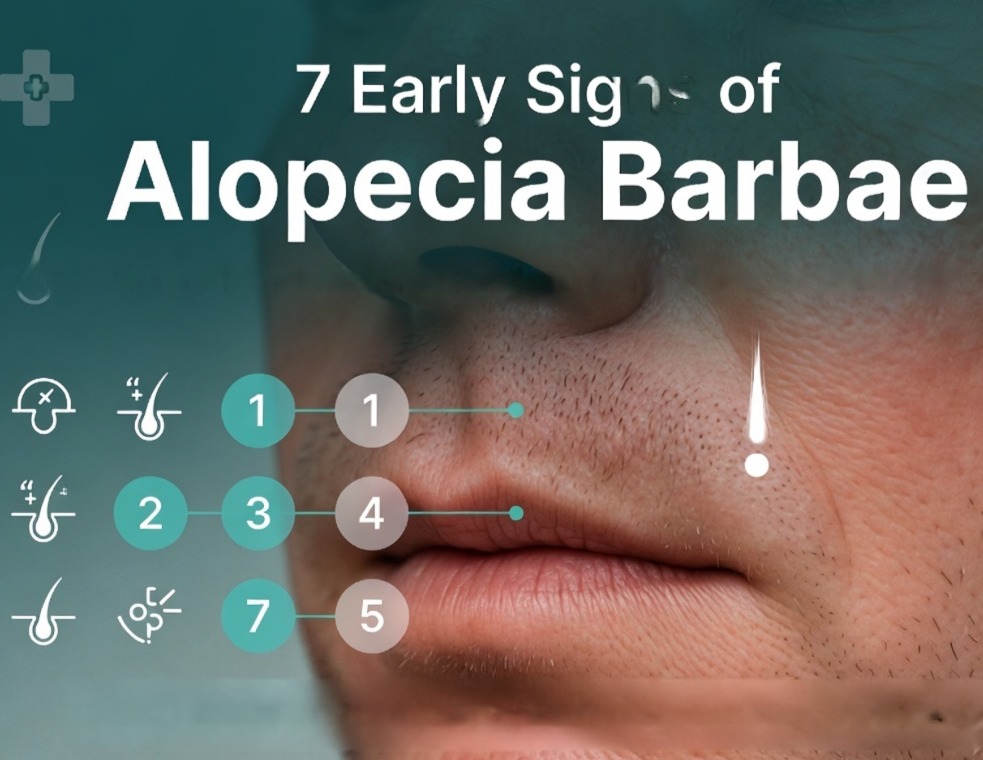

For many men, the mustache is a badge of identity—a symbol of style, masculinity, and confidence. So, discovering a tiny bare spot in that dense foliage can be unnerving.
If you are noticing a smooth, coin-shaped gap in your stache that wasn’t there last week, you might be looking at Alopecia Barbae. This autoimmune condition doesn’t just target the scalp; it frequently attacks facial hair, and the mustache is often ground zero.
The good news? Early detection stops the spread. By recognizing the warning signs immediately, you can intervene with the right treatments (like those found in the Cosmoclinic-20 range) to regrow hair and restore density.
Here is the dermatologist-approved checklist for spotting Alopecia Barbae in your mustache region before it worsens.
What Exactly is Alopecia Barbae?
Before we look at the signs, it helps to understand the enemy. Alopecia Barbae is a form of Alopecia Areata (the autoimmune disease where the body attacks its own hair follicles) that specifically targets the beard and mustache area .
In the mustache, the hair is often coarser and more sensitive to androgens. When your immune system misfires, it sends inflammatory cells to the follicle, forcing it to stop producing hair . This leads to the sudden appearance of bald patches.
The 7 Early Warning Signs in the Moustache
Don’t wait until the patch is the size of a quarter. Here is what to look for in the early stages:
1. The “Quarter-Sized” Circular Patch
The most classic sign. You will notice a perfectly round or oval patch of smooth, hairless skin. Unlike razor burn or ingrown hairs (which look bumpy or red), this patch will look completely smooth and shiny . It usually starts small—about the size of a dime or a pencil eraser—and expands if untreated.
2. Sudden “Moth-Eaten” Edges
Instead of a clean bald spot, you might notice the density of your mustache thinning in a specific area, creating a “moth-eaten” appearance. The hairs at the border of the thinning area become sparse, making the mustache look uneven or patchy .
3. The “Exclamation Mark” Hairs
This is the gold standard diagnostic sign for Alopecia Areata. If you look closely at the edges of the bald spot (using a mirror or magnifying app), you might see short, stubby hairs that are narrower at the base and thicker at the tip. These are “Exclamation Mark” hairs, indicating the immune system is actively attacking the follicle root .
4. Itching or Burning Sensation
Contrary to popular belief, hair loss doesn’t always happen silently. In the 48 hours before the hair falls out, many men report a specific sensation in the mustache area: a mild itch, a burning feeling, or even a “crawling” sensation (formication) . If your mustache feels irritated but you don’t see a rash, take a photo—hair loss is likely coming.
5. Sudden Whitening of Hairs
Sometimes, the hair doesn’t fall out immediately; it loses its pigment first. You might notice a cluster of white or grey hairs in a localized spot of your otherwise dark mustache. This is called poliosis, and it occurs because the immune system attacks melanocytes (pigment cells) along with the follicle .
6. Yellow Dots at the Follicle Openings
If you look very closely at the bald spot, you might see tiny yellow dots. These are not pimples; they are keratin plugs (debris) stuck in the empty follicle openings. Dermatologists look for this under trichoscopy (a magnifying lens) .
7. The “Pepper” Pattern
Before total baldness, the area may look like it has “pepper spots”—short, broken hairs that refuse to grow longer. If you notice your mustache feels “stubbly” in one area but the stubble never grows out, the growth cycle has been interrupted.
How to Stop It from Spreading (And Regrow Your Stache)
Once you spot the signs, time is tissue. The sooner you act, the better the chance of full regrowth.
Step 1: Eliminate Irritation
Stop shaving the affected area. Shaving creates micro-cuts that can worsen inflammation. Use a gentle, fragrance-free face wash.
Step 2: Stimulate Blood Flow
Because Alopecia Barbae involves follicle inflammation, you need to wake up the dormant roots.
Step 3: Target the Inflammation (The Medical Fix)
While a dermatologist may prescribe steroid injections, there are topical solutions that support regrowth.
The Role of Minoxidil (The “Off-Label” Hero)
While not a cure for the autoimmune issue itself, Topical Minoxidil 5% is the most effective tool to force the mustache hairs back into the Anagen (growth) phase.
Clinical studies, including a notable 2024 case report on identical twins, prove that consistent use of 5% Minoxidil significantly increases hair density in the beard and mustache area, even where loss has occurred .
For USA buyers looking to combat patchy mustache loss, the Cosmoclinic-20 range on Amazon offers a high-quality, affordable entry point into this treatment.
Recommended Products from Cosmoclinic-20
If you want to fight back against Alopecia Barbae, you need consistency. Here are the top-rated solutions available on Amazon USA to help fill in those patches.
1. The Regrowth Powerhouse
Cosmoclinic-20 Minoxidil 5% for Men
This is your first line of defense. Apply 1ml twice daily directly to the bald spot and the thinning edges of the mustache. Most users see vellus (peach fuzz) conversion to terminal (thick) hair within 3-4 months.
👉 [Shop Cosmoclinic-20 Minoxidil 5% on Amazon] (Affiliate Link)
2. The “Micro-Roller” Booster
Cosmoclinic-20 Derma Roller Kit
Research suggests that microneedling (using a derma roller) increases the absorption of Minoxidil by up to 40% . Using a 0.5mm roller creates micro-channels that drive the active ingredients deeper into the inflamed follicle zone.
👉 [Shop Cosmoclinic-20 Derma Roller on Amazon] (Affiliate Link)
3. The Nourishing Support
Cosmoclinic-20 Biotin & Collagen Shampoo and Serum
While Alopecia Barbae is autoimmune, weak hair breaks faster. Biotin strengthens the surrounding hairs, preventing the “moth-eaten” look from spreading due to breakage. Use this to keep the non-affected areas thick.
👉 [Shop Cosmoclinic-20 Biotin Complex on Amazon] (Affiliate Link)
Why the Moustache is Stubborn
Regrowth in the mustache can be slower than the scalp because facial hair follicles have shorter growth cycles. If you are using Cosmoclinic-20 Minoxidil, do not give up if you see a “shedding phase” at month 2. This is the weak hair falling out to make room for thick, healthy terminal hairs .
When to See a Doctor:
If the bald spot continues to grow despite using Minoxidil for 4 months, or if you develop bald spots on your scalp or eyebrows, you may need prescription corticosteroids or JAK inhibitors .
The Bottom Line
Discovering a hole in your mustache is stressful, but it is not the end of your style. By recognizing the “Exclamation Mark” hairs and smooth circular patches early, you have the power to reverse the condition.
Equip yourself with the right tools from Cosmoclinic-20 on Amazon, stay consistent with your application, and give your follicles the fighting chance they need.
Disclaimer: This article contains affiliate links. As an Amazon Associate, we earn from qualifying purchases. This information is for educational purposes and does not constitute medical advice. Always consult a dermatologist for a definitive diagnosis of Alopecia Areata.